.
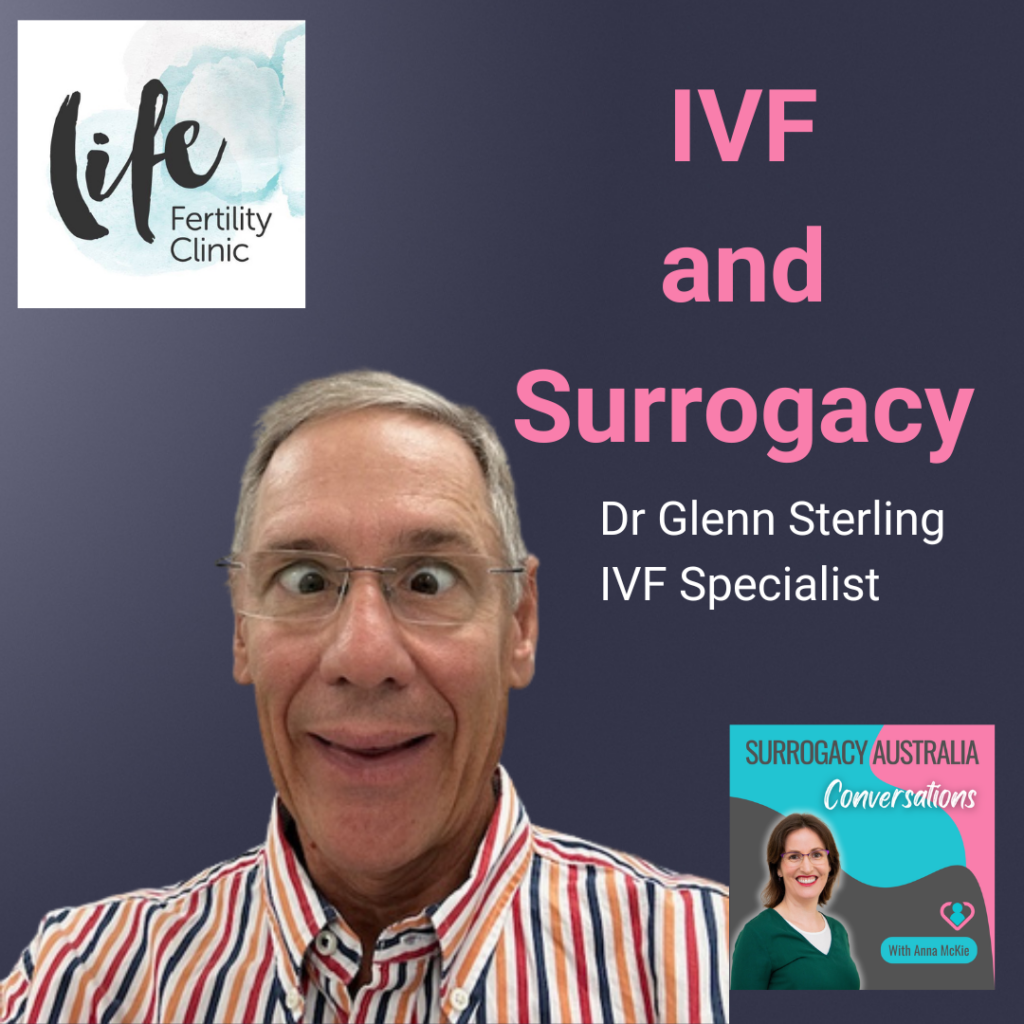
Episode 148 – Dr Glenn Sterling – Life Fertility
As well as consulting on all issues of infertility and assisted reproduction, Glenn continues to practise as a gynaecologist and laparoscopic surgeon for patients with endometriosis and tubal factor infertility. His surgical skills allow him to address underlying causes of infertility while providing comprehensive IVF services.
If you’d like to arrange your own session with Dr Glenn, you can find him on the website.
We hear from Glenn and cover questions such as:
❤️ How are the eggs collected from my donor?
🧡 How are the embryos made and genetically tested?
💛 What tests will the surrogate need?
💚 How is a surrogate’s menstrual cycle tracked prior to embryo transfer?
💙 Who is present at embryo transfer?
💜 Can a surrogate have a natural cycle instead of medicated?
This episode was recorded in April 2026.
To see the slides described in this recording, watch it on our YouTube channel.
.
These podcasts were recorded as part of the free webinar series run by Surrogacy Australia. If you would like to attend one, head to this page for dates and registration links. The recording can also be found on our YouTube channel so you can see the photos that are described. Find more podcast episodes here.
The webinars are hosted by Anna McKie who is a gestational surrogate, high school Math teacher and surrogacy educator working with Surrogacy Australia and running SASS (Surrogacy Australia’s Support Service).
Follow Surrogacy Australia on Instagram, Facebook and YouTube.
Are you an Intended Parent (IP) who is looking to find a surrogate, or a surrogate looking for Intended Parents? Join SASS.
00:14
Welcome back, or if this is your first time, thank you so much for taking the time to listen to Surrogacy Australia’s podcast series with me, your host Anna McKie. My guest on this episode was a co-host on the regular webinar series that I run. Those one-hour webinars are free and will take you through the surrogacy process in Australia. You will hear from a surrogate or parent and there are opportunities to type in your questions and we will try to answer them. You can find upcoming dates on our website at surrogacyaustralia.org.
00:44
This episode, recorded in April 2026, was different to the standard webinars as it featured Dr Glenn Sterling. In this episode, Dr Glenn takes us through an overview of IVF in relation to surrogacy. Glenn is a fertility specialist with Life Fertility Clinic in Brisbane, of which he is the founding director and owner. As you’ll hear, this conversation was light-hearted in many ways, with Glenn and I bantering and bouncing off each other. He is a character and unique in his no-nonsense approach.
01:13
one that I find very refreshing. I think you will come away from this recording feeling ready to ask your own IVF specialist questions so that you can pilot your own journey with your doctor by your side. I hope you enjoy this episode. My co-host tonight is Dr. Glenn Sterling, a little brief bio in him, as well as consulting on all issues of infertility and assisted reproduction
01:36
Glenn continues to practice as a gynecologist and a laparoscopic surgeon for patients with endometriosis and tubal factor infertility. His surgical skills allow him to address underlying causes of infertility while providing comprehensive IVF services. He’s also very well known in the egg donation and the surrogacy community. And so that’s in some ways part of our focus tonight. Welcome Glenn, thank you for joining us. It’s an absolute pleasure. I have to say to sitting there watching you in the introduction.
02:01
You’re a legend at this. I never realized that you’re so good at this sort of thing. You should be on television in some regard. It’s fantastic. Well done. Carry on. I love it. Thank you. I appreciate that. Thank you so much for inviting me. It’s always been an important part of my practice to the point now where I suppose probably 60 to 70 % of my cases are girl, girl, boy, boy, single women, surrogacy.
02:25
egg donation and something and I think only a very small portion of my practice now is, and certainly in the minority, is heterosexual issues. So it’s been an important part of my career and I like it. It’s fun. It’s good once you’ve kind of done all that foundation work and then you start to move into some more unique branches of the work that you do. 100%. Although I suppose at end of the day, all I really need is an egg and a sperm and a uterus.
02:49
The combination of those things, where you put them, where they come from and where you distribute them to, oh really depends on other people, right? The patients, the intended parent, the birth parent, the lawyers, the psychologists. I mean, from a clinician point of view, we need to make it safe and we need to offer alternatives to people.
03:11
reality, it’s pretty simple for us as a clinician. Yeah. I think if you’re a doctor that judges people and tells them what they can and can’t do, I think it’d be a very difficult job to do and you probably would enjoy it. But I’ve always taken the view that, you know, I’m not here to judge people. I’m not here to tell people what to do. You present the options, you support them no matter
03:30
and let them do what they wanna do within the boundaries of what we are able to And I think we’ll unpack that more and people will hear that as a bit of a theme for you and your style that you’ve often been somebody who’s a little bit left field and being prepared to be a bit different and to push those boundaries. And yes, there’s a guidelines but let’s be a bit more flexible with the people. Yes, there’s a medical side. Well, yeah.
03:54
And Anna, I suppose it’s when I’ve had a half a dozen red wines on a Saturday night and I’m with people that have children with ADHD and that sort of thing. I always raise this issue of how is it possible in life to make a difference if you’re not different? Interesting. And I think that we as a society try to bring everybody back to what we consider as normal. Is that a good thing? I mean, you look at people like Elon.
04:19
You look at people like Picasso, you get all these incredibly crazy people and they do things out in left field. But if they didn’t do it, we’d still be in a world that it doesn’t change, right? So look at what’s happening now with Donald Trump. Do you think he’s normal? Do you know what I mean? I mean, these sort of people are off the Richter scale crazy, but the
04:39
You’ve got to be different to make a difference. So I ask people to consider that as they go through life. Don’t try to make everybody normal. Allow them to express themselves and allow them to be who they may not necessarily conform to society’s norm.
04:55
let them do that. It’s like our children, don’t give them tablets to bring them back to normal. Let them be. We could be killing Einstein by giving them tablets and stuff. You’ve got to let people be different to make a difference. You can’t progress mankind if you don’t try different things. See, I knew this webinar would be fantastic. We don’t even have to get to the plan stuff. Like, as a mother though of an ADHD son, and I’ve had an autism diagnosis myself,
05:20
But it’s tricky though, and as I’m a high school maths teacher, as my other job, there is a society where we have to get kids to conform to get through the education system. there’s some- why? But why? Well, exactly, but it’s there.
05:33
Yeah, but I feel like we could just end the webinar now. You have given me gold nugget there. You have to be different to make a difference. Like I have a good friend, superintendent of police and he and his wife were taking their daughter to the doctor. She’s seven. mean, she’s just off the risk of crazy kid. Right. And they’re about to take it to the doctor to get some tablets to settle down. And I had this conversation with them and they haven’t done anything.
05:56
since then, that was three years ago. This kid is absolutely flourish, know, top of the class, doing so many wild and different things. I just think as a society, we need to be a bit careful about restricting people and bringing them back to the norm. Let people be different. They are the ones that will make a difference to the world and mankind. So don’t, if you’ve got a kid that’s a bit different, great, know, embrace it. Don’t try and suppress it. I think it’s an interesting thing that we all need to think about.
06:24
Definitely. Yes. This is going to be great. Just on a side note, Glenn, like speaking about being different, like how many people have the audacity to go, yeah, I could start and run a national support service for surrogacy. Sure. I’ll give that a go. Honestly, I see surrogates all the time and I had no idea you did all this stuff. So this is quite educational for me. you. you. So Glenn and I reconnected last October when I was up in Brisbane and we were at an awards night. So two lads, Alex and Carlo.
06:52
and their surrogate M have started a week to celebrate donation and surrogacy and it culminates with an awards night at the end of that week so that’s two years they’ve been running that now so they are cool guys they are and again they like they want to make a difference in April 2018 this was when I met Glenn for the first time I mean we had some like consultations online I
07:13
I have been an egg donor three times and this was my third egg donation. This costume that I made for the first donation was made out of all the packaging materials that come with all the IVF drugs. So if anybody can see closely or have done it before, there’s all the casings on my t-shirt with a Gonal F pen sat in. My skirt is made out of the information leaflets. The silver stars are made out of the inside of the alcoholic swab wipes. They all seem so conservative people from Adelaide and then this woman turned up and it was there.
07:42
I couldn’t believe there’s a lunatic in my waiting room, but we had the funniest day. was fabulous, wasn’t We did. Well, one lunatic to another. And then when I was up in Brisbane last October, so this is the Queensland family that I donated to and the little girl there, Miriam.
07:57
She’s seven now. All my donor kids are seven actually. The mum and dad in that photo, Bec and Steve, Bec was able to carry Albert there first, but then she needed a surrogate and an egg donor to have anymore because she’d had a hysterectomy. So life goes on and friendships continue. yeah, okay, I remember now, okay. Yeah, surrogate was Katie. Yeah, they tried their own embryos first, but ran out. And then I offered to be their donor. We’d never met in person by that point, but we’d been friends in the online communities for a couple of years by that point.
08:25
That’s my story. Okay, we’re gonna do a few questions here that I had said put in the social media promotions, the questions we might ask Len. And then once we’ve gone through these, I’ve got a few to ask him and any that people have. Is it possible to give us a crash course roughly for people who are absolutely brand new to the IVF world? How are the eggs collected if it’s from a hetero couple or if it’s an egg donor? Look, I mean, I suppose up until the…
08:50
early 1990s that a lot of eggs used to be collected lapis-copically. In other words, you’d have a full anesthetic would go through the belly button and suck the eggs out through the little portholes in the tummy. I think probably since, I’m just trying to guess when exactly because time does go quickly, but probably from 18, 20 years ago now, I don’t think there’s been any egg collections done that way. In fact, it’s being mandated that we don’t. So all egg collections are done basically vaginally. You will get people where the ovaries run.
09:18
really high in their abdomen where you can go through the skin of the abdomen to get to the eggs but it’s still done with ultrasound. We don’t usually do any laparoscopic or look through the belly button type procedures at all anymore because the morbidity and mortality is just too high. So all the egg collections are done vaginally. So I do have a woman at the moment for example that is very dear to my heart. She’s a wonderful woman.
09:41
girl but she’s a classic example where you need surrogacy for all sorts of reasons. Now this girl was born with what we call the Meyer-Rokotansky-Hauser syndrome and what that means is that she was born without a uterus and without half of a vagina. So we stimulate her with the hormones that come from your pituitary and higher doses to create ovaries with more follicles and more eggs and then to collect the eggs vaginally. In her particular case, because her vagina is only half the length of a normal
10:07
It’s reasonably uncomfortable for her, but she still does it under local. And we get to the ovaries vagina. So the ultrasound probe goes in the vagina. You put a needle guide over the top of the ultrasound probe, and then you just run a needle up into the ovary through the skin of the vagina. So a lot of women think their ovaries sit up around their kidney sort of thing. They don’t. They sit down generally at the top of the vagina. They’re very easy to access vaginally. I do probably 95 % of my ovary collections under local these days rather than an anesthetic.
10:35
There’s various reasons why 95 % of our patients just want to have it done that way. It’s cheap, it’s quick, they drive themselves in, they drive themselves home, but they probably shouldn’t, but they do. And they don’t waste the whole day getting over their anesthetic. So egg collections have evolved dramatically over the last 15 years, I suppose, but they generally are all done for giant, very, very simply and very quickly. It only takes 10 minutes to suck eggs. In the old days, we’d have a needle in the ovary, in a follicle where the egg comes from, and we’d suck the fluid out.
11:04
the egg would come with it, but we also used to flush in and out, flush in and out with cultured milk to get the eggs out. And we don’t even do that anymore. We just put the needle in, it, and that’s it. So because we only suck the fluid out and then we don’t flush it, we only need a single lumen needle. So the needles are much smaller. So the pain’s less, the bleeding’s less, and the trauma’s a lot less than what it used to be as well. So it just continues to evolve. But the egg collection is a pretty simple sort of procedure, particularly if the woman’s deli-
11:31
vaginally before. To be frank, when you deliver a baby vaginally, lot of the nerves at the top of the vagina aren’t intact anymore. So I had a girl today that was an egg donor for a couple of guys and she had the egg collection. had two babies vaginally before. We did the egg collection. had not slept a wink. She was terrified. I saw her in the waiting room and I said, you know, my old line where I say, you know, are you nervous? And she said, yes, I am. I’m terribly nervous. And I say, yeah, so am I.
11:58
And I said, but don’t worry, I’m sucking eggs with this hand. It’s going to be fine. Anyway, so she went through a procedure, didn’t even feel the local going. She felt nothing. We suck the eggs. She walked out of there and it was just simple as. So it’s actually very simple and straightforward these days. Yeah. Even since I did that egg donation in 2018, clearly that’s come a long way. And as you say, medicine just keeps evolving. So who knows where it’ll go in the future. eh Precisely. We got to get about somehow though. That’s the thing.
12:26
Well that is true, right? Yes, no AI for that. I don’t think so. Another common question among the community is, as intended parents, can you explain how genetic testing works and should we ask our IVF clinic for it? Look, wherever the egg’s coming from and wherever the sperm is coming from, the originators of those gametes, I think the standard these days is that we, as a profession, as doctors, should at least offer the patients that are going to be the recipient of the trial.
12:56
we should be at least offering them to do not only structural chromosomal testing, but also what we call autosomal recessive testing. So a lot of people listening will know what I’m talking about. But for those that don’t, you can have structural abnormalities of chromosomes. For example, a kid that has Down syndrome, instead of having just two chromosome 21s, because we all have 23 pairs of chromosomes.
13:21
Instead of having two chromosome 21, one from mom and one from dad, there’s an accident in nature where the child ends up with three lots of chromosomes. So these are major structural abnormalities of chromosomes that can lead to major chromosomal abnormalities in children. So Down syndrome is the classic example of that. There’s a whole nother group of chromosomal
13:41
or genetic abnormalities that’s a whole different world. And this is what we call autosomal recessive genetic testing that we need to consider these days because the reason we need to consider is that we can test for it. And not only can we test for it, we can also biopsy embryos and exclude embryos that have these diseases. I always, I try to put it to patients that the difference between a structural chromosomal abnormality and a point mutation abnormality
14:09
in your genes or one of these serious metabolic conditions is a little bit like the difference between understanding on a map where the road leads between Brisbane and Sydney. There’ll be this big structural thing called a Pacific Highway that goes to Sydney. There’ll be another one called the Inland Highway that goes from Brisbane to Sydney. That’s the structure of your chromosomes. Now these other genetic problems that we have…
14:31
basically a point mutation on the genome. So 1.71218 kilometers outside of Coffs Harbor, there’s a pothole in the highway. Now that’s what we call a point mutation or a genetic issue that if mum and dad or the egg and the sperm carry the mutation, there’s a one in four chance that the kid can inherit. Mum and dad have to both have the mutation such that the kid ends up having on both its gene the mutation. it’s
14:58
Call it an autosome recessive because if the mom has it, the gene is recessive if only one of the genes are affected. Now, if the child has both the genes affected, one from mom and one from dad, they can have…
15:11
very serious metabolic disorders. And the classic three that the government has offered to screen for since November, 2023, cystic fibrosis, spinal muscle atrium, fragile legs. They account for 25 % of children that end up in the children’s hospital with serious metabolic disorders. They die early, they can have a terrible life and premature death. Those three mutations, I’ll emphasize, only account for 25 % of serious metabolic disorders. The other 75 % can be detected.
15:38
what we call the expanded carrier screening. The expanded carrier screening is not paid for by the government. That’s about a five to $600 test, but they screen for four to 600 mutations. Very, very comprehensive tests compared to just the three autosomal recessive conditions. So when you’re about screening patients for genetic mutations, you’re not only looking at structural cramzoma problems, you’re also looking for point mutations in the genome. So my job as a doctor is to say, hey, you guys, this is what we can do.
16:07
Now what you do, even people where you can get a free test to check for cystic fibrosis, I’ve had mums and dads where the father or mother have cystic fibrosis and they look at me like I’m some sort of bloody weirdo and they say, hey listen, I’ve got cystic fibrosis, I’m leading a pretty good life, why the hell would I want to stop a kid coming into the world that’s like me? So my job is just to explain to you what’s available, your job is to consider all your options and determine.
16:31
test you do and how you might intervene. Now that’s all dependent upon your religion, your philosophy, you know, how you feel about embryos, where am I going to throw them? So all of that stuff, that’s not my job. That’s the patient’s job. My job is just to explain to you what’s available. And yes, you should consider that.
16:47
But what you do about it’s none of my business. My business is here to support you and get you through what you decide to do, not make decisions for you. And again, I’ll get back to that thing that as a doctor, I don’t think we should ever judge our patients or tell our patients what to do. Our job is simply to explain to you what’s available and be nice along the way because at the end of the day, you’re paying me so I put food on my family’s table. Doctors shouldn’t be rude to patients or tell them what to do. It ain’t our job. Yes. Oh, very well said there. And I think…
17:16
lots to take in in terms of it started with the classic the down syndrome the trisonomies in terms of those we are an understanding genetic testing
17:24
can’t rule out everything and there’s no guarantee whatever healthy baby is. As I can see, Adrian has mentioned in the comments though, sometimes in surrogacy, we might encourage it a little bit more often because you’re putting a surrogate through each of these embryo transfers and having to make, if things are going wrong along the way, decisions. That is absolutely true. But again, it’s not my job to tell people what to think of what they do. That is where uh a woman who’s going to carry a baby for another couple, this is where it’s so important
17:54
before anything happens that you need to consider that situation. And if the baby inside my tummy has Down syndrome, what are we gonna do about that if that arise? Now the reality is it’s either 100 % is gonna happen or zero. So you need to consider the 100 % and in that circumstance before we kick off, what are we gonna do? That’s the job of the surrogate. We’re not dealing with village idiots. We’re dealing with very intelligent people that do this, right? And they can discuss these things beforehand.
18:23
and have a plan in place as best you can. Now, all the circumstances are never going to be covered. Of the circumstances we might find ourselves in, but you can cover a lot of them before you kick off. Definitely. And hence why there’s counselling involved in that the lead up to before any of these pregnancies and embryo transfer so that teams can have those conversations. In of surrogacy and egg donation.
18:43
all these things. This is why I say to you that my job is very, very simple. I mean, I just need an egg and a sperm and an embryo and put into a uterus. That’s all I need to do, right? But all of that other stuff, counselling, lawyers, all that, that’s where the difficult bit is with this whole surrogacy business. I will read out an anonymous question that’s been typed in. This particular person said they did McKenzie’s mission testing and does that testing differ to PGT? Okay, so just to educate people,
19:11
The then minister, federal minister of health was a guy called Greg Hunt. And Greg Hunt is one of the, well he, in my view, he was the best federal minister for health this country has ever seen. He was an incredibly smart guy and he was incredibly involved in the pharmaceutical industry. He understood the drugs, he understood people’s plights. And one of his staff members had a child with spine muscle atrophy and that child died within a couple of years being born.
19:37
and he was very taken by this. So that child’s name was Mackenzie. So what Greg Hunt did was he ran a pilot program in Sydney looking at spinal muscle atrophy, fragile X, and cystic fibrosis. As I mentioned, they’re the three common genetic mutations for the point mutations, not the structural ones, the point mutations. And so they ran a pilot program and it became apparent that by testing people, the woman, testing these things, if your woman becomes positive, then you test the dude.
20:07
where the sperm’s got, you don’t test both of them to begin with, it costs too much. So you just test the woman to begin with. If she positive test the man. And if they both have those mutations, say the spinal mysotrophy, then once they create embryos on day five, you can bias the embryos and highlight the ones that are normal and those that are not. So this was a pilot program ran, can’t remember.
20:26
whether it was in countrywide or there’s a specific geographic area. But as a result of that McKenzie’s project, it became enacted that in November, 2023, the entire country, any woman that was planning pregnancy or any woman that was pregnant was offered this autosomal recessive screening program, which is for the three commonest mutations. But don’t be fooled, it only covers 25 % of children who are in hospital. So the other 75 are the expandicare screening.
20:51
So McKenzie’s mission led to the Medicare rebate of testing of women for these three common autosomal recessive disorders. That’s what that’s all about. That’s not the structural chromosomal problem. And by the way, we all need to remember that when you’re assessing pregnancies, you gotta remember that genetics is only half the issue. This is why we do ultrasound to look for structural developmental problems. So the classic example where you can have a completely normal chromosome.
21:18
a chromosomally normal child, be it point mutations or structural problems, but then they can have a major problem with spinal bifida, right? So you can have normal chromosomes and a real problem. On the other hand, you can have an anatomically completely normal child, but chromosomally a problem, i.e. Down syndrome. So this is where you’ve got to remember that chromosomes…
21:38
Genetics is not the whole story. Anatomy is also. So when women are in their pregnancies in 13, 14 weeks, whatever, we sort out the chromosomes, but it’s also super important to get those high-definition oxygen stunts so we check out the anatomy. There’s two aspects to this. It’s a lot. I’m going to be a surrogate for my inter-appearance. What test would I expect to have before the month we try to get pregnant? Well, it should be sorted out well before the month beforehand.
22:02
But look, I suppose the art of actually listening to patients is long lost. If you’re American, the last thing you do is listen to what a patient’s saying and you go and do a thousand tests right now. My view and being brought up in the British system of medicine is that you actually listen to a patient. So if a woman comes in, there’s going to be a surrogate. And she says to me, uh
22:20
I have had two children, I fell pregnant with my husband walking past the end of the bed and I have a normal 28 day cycle. The chances of any blood test picking up a problem is remote. So it’s much more important to listen to the paper. But you know, we will do the routine blood test, HIV, all that sort of stuff is done well before any embryo transfer. I think sometimes surrogates are often, as you say, the fertile women and so they didn’t need IVF. So they
22:43
wonder about all these checks. Is it common in your clinic where you might do a month, some months before the pregnancy where you track her cycle to make sure that she does follow a pattern and she ovulates? Not really. And the reason is, is that if you’ve got a woman who’s got a 28 day cycle or
22:58
cycle. What’s the point? mean, you know, now the other thing is that a woman has a regular monthly cycle, know, 28 day cycle, 30 day cycle. When it comes to the month where she’s going to be the surrogate, you know, the excitement, the stress and everything, that’s the month where they play up like a second hand lawnmower anyway. there’s not much point really. On the other hand, you know, no matter what’s going on with the surrogate, we keep a very close eye on them in that month where they
23:21
where we’re going to do an embryo transplant to ensure everything’s perfect. Now, keep in mind that every embryo we play with, I think it’s really important that everyone remember, every embryo could lead to 100 years, if not longer of life. We’re not mucking around with a pack of cells. We’re not mucking around with, you know, just a sperm or an egg. We’re dealing with a pack of cells that could lead to 100 years of life. So to cut corners, to not…
23:47
make sure it’s perfect, to rely on the previous month’s cycle or whatever is unacceptable. Everything’s got to be perfect the month you put that embryo in the uterus. So just keep in mind if you’re wondering.
23:58
you know, oh, the doctor canceled the cycle because I had a spot of blood after intercourse two days before transfer. You know, we’re dealing with a life that could be a hundred years. You can’t take shortcuts. You know what I mean? The embryo is so precious. You must understand it. And people get pissed off and they get irritated and they get annoyed at some of the, we cancel this and do this. And you know, but I’m flying from Perth. want this goddamn embryo transferred. I’m like, well, no, that’s a hundred years worth of life that we’re dealing with here. You got to keep that in mind.
24:26
That’s interesting. Hopefully people listening can sort of take away some of that and chat to their own doctors about that, which leads probably onto this question here that as a surrogate, can I ask my doctor for a natural cycle as opposed to one where there are lots of medications? So that’s what I did as a surrogate for people that don’t know. There’s some ways where you just sort of observe the cycle, do the blood tests and check for ovulation. But then there are other clinics that might recommend medicating her to be for a cycle is a regular, for example, to put it into a particular pattern. Is it OK?
24:55
Do you believe, Glenn, for people to ask to be proactive in us? I think from my perspective, if a person lives a long way away, one of the reasons we do a medicator cycle is for logistical reasons. The other reason we tend to do it is if someone has an irregular cycle and their cycle is unpredictable, it can drive people insane, mainly the patients in the surrogate, right? You go and have 13 scans before you actually ovulate. So for those two reasons.
25:22
They’re the common indicators that people might use estrogen to control the situation. So if I have someone on a medicated cycle and they live in, I had a lady that used to come from a property, she’d have to travel 13 hours by car to get to, I think, Springs and then she’d have to fly to Brisbane to have a transfer. Now that sort of logistical issue, if you’ve got that going on,
25:42
then you want to be able to control the scenario a bit. when you’re doing a natural cycle, it’s very difficult to control the situation in terms of ensuring that our timing is perfect. But if a woman’s living in the next suburb or where it’s easy logistically, think that a natural cycle, the statistics would suggest that natural cycle they do slightly better. I mean, I myself would I want to be filling myself through tablets every day when I can just let my body do the job. let my body do the job. So we tend to use natural cycles whenever we can. But occasionally for logistical reasons,
26:12
or if someone has an irregular cycle, they’ve got PCO, they never have periods or whatever, will we take control of situation because we want to make things perfect?
26:20
the embryo transfer. by far in the way I think the majority would be in natural cycles these days rather than using estrogen tablets and then subsequent progesterone. Now don’t forget women that do have a natural cycle where they ovulate themselves. In 30 % of women they do not produce enough progesterone to maintain a pregnancy for whatever reason. So I can’t remember the dude’s name out of Paris but he established very clearly that in a natural cycle where you rely entirely on the ovary to produce the estrogen and then subsequent progesterone and implantation, 30 % of cases they don’t produce enough
26:50
So even in a natural cycle, we tend to use supplemental progesterone vaginally or via injection after the, you know, leading up to and after the embryo transfer just to ensure that we’re not risking anything. Well, on that, when I became pregnant as a surrogate that I was trying to advocate for as natural as possible, but that was the sort of the compromise we did with my doctor that we did natural in the lead up, but then we did two progesterone injections, I think.
27:16
post-transfer to try and help that body start that. It’s like if I explain to you and you understand why I want to do this, you’re much more open to it, right? It’s like women that say, you know, I want two embryos in the uterus. And then I explained to them, well, if you fall pregnant with twins, you’ve got a 2,600 % greater risk of cerebral palsy with one or both your twins. Suddenly the women start saying, you know what, I think I’ll go to one embryo. Thanks very much.
27:40
So I think that a lot of these things, if you understand the reason why we’re saying it rather than us just telling you what, see how I don’t like telling people what to do. I want them to understand why I’m saying something. Once they understand it and they understand that that’s not my opinion is based on the research. And if they understand that and they understand, know, I don’t want to be pushing wheelchairs around with children for the rest of my life twins. I’d rather just have one twin now and the next twin in two years time. And then everything’d be sweet. just, you know, people will come in and I’ll,
28:09
twins and want twins and then they walk out of the room and they go there’s no way on earth I want twins, you know what mean? Because I understand now, I’m a twin myself, naturally conceived, I’m a twin brother. It’s an interesting thing that I think as parents we all, you know, when we have a child we say oh my, you know, my child is the smartest kid on God’s earth, right? We all say that, don’t we? Right? Okay, now if you have twins and they have subtle cerebral palsy, right? So a lot of twins have subtle things that are going on.
28:36
Now is a parent ever gonna go out there and say, my kid’s got, he’s got this beefy? Of course you’re not. You’re gonna turn around and you’re gonna say, my twin is the smartest kid on earth. not all kids run into trouble, but a significant number do. Now if you’ve got a kid with a subtle bit of cerebral palsy, whatever, no parent’s gonna tell anyone on the planet that there’s a problem with the kid because you love your kid and you want your kid to do well and you don’t want any negative feedback and you just support your kid no matter what.
29:02
So the reality is though is that a lot of twins do have issues and people don’t, know, they say, oh, I’ve got a friend that’s got twins and there’s no problem. Well, you don’t know that there might be a problem.
29:11
So just what I’m saying, so we’ve just got to present the evidence. And then when people hear that, they go, you know what? I don’t want two embryos in my body. I don’t want one because it makes sense not to do two. I’m built for one, not two. Yeah. As a twin, I’m sure that’s the type of twin like teasing that we would do to each other going, oh, well definitely Matt was the one that got the defects without a doubt. Exactly. It’s a dramatic, you say 2,600 % greater risk and that is, but it comes off a really low base. So I say that to discourage people that have two embryos put body. In fact, if we put two embryos in the
29:41
if anyone less than 40 these days, we get in trouble for it anyway. if you only have one embryo on the body, don’t forget it’s a 1.4 % chance you can get twins, right? 1.4%. The incidence of having triplets with a single embryo is one in one million. And a year ago, it happened to me. I had a woman that had triplets off one embryo and everyone went, wow, that’s fantastic. You know what she did at 14 weeks? She terminated the pregnancy because the evidence is overwhelming. These cerebral injury because they’ve got
30:10
the same blood supply is overwhelming that they all end up with terrible outcomes. So she terminated the pregnancy. It was sad, but you know, again, would I have done the same thing? I don’t know, given my sort of philosophy of life, but I’m just here to support them what they do. I think she made the right decision at the time.
30:30
She’s since pregnant again, thank goodness. It’s all good. Glad to hear. And just for people who might be new to surrogacy, just letting you know, in Australia for surrogacy, we don’t do twins. It’s not something that we encourage. Well, 1.4 % of them split in two and you can’t avoid it, but we’ll only put one embryo in the uterus is what Anna’s trying to say. Yes. And in my nine years in the community, I know of one surrogate where it split, but it miscarried at about 12 weeks anyway. Right. right. What?
30:56
We’re gonna do so people feel free to be typing in your questions. I can see one’s come through, but I’ve got some questions that I wanna see if we can do like a quick fire for Glenn and just see if we can like get you some quick answers without dwelling on it too much, right? Catch me off guard. I’ll be gentle mostly. All right, here we go. Where do you see the fertility industry progressing in the next 20 years? I think that the fertility industry will see
31:22
a shift of doctors from old white males to young multicultural females. doctors I’m talking about. I think that there’ll be a lot more regulation with regards to what we do, but as an industry evolves, any industry evolves, regulation and controls are going to become much greater. So I think that we will become more regulated. I think there’ll be better record keeping. I think there will be… uh
31:51
government-led restrictive practice. Is that a bad thing or a good thing? I don’t know. Will it help the evolution of especially? Perhaps not. I think there’ll be a lot more corporatization of doctors. uh I don’t think that that is necessarily a good thing. I’ll give you an example recently that was Monash with the mix up with uh the M-rays and so on now. People might not be aware, but Monash is one of the groups that uses computerization to try to.
32:19
prevent these problems mixed up with embryos. Now in doing so, I believe what’s happened is that with barcodes or whatever they use, whatever system they have in place, that the scientists have become more reliant on a computer to try oh to, relying on the computer to stop mistakes happening. Now a computer or a system like that,
32:38
will keep a record of whether you do the right thing or the wrong thing, but it won’t prevent it. what’s happening is that they’re becoming lackadaisical themselves because they’re relying on the machine. So I think that we need to be very careful about the…
32:51
of technology rather than as humans maintaining some control of situation. Now on the other hand, no matter what industry you’re in, any human involvement will involve human error and you will never get away from it. So I don’t think you’re ever going to get away from human error, it’s always going to happen. But I do see corporatization, I see a different group of doctors coming along, I see much more regulation, I see…
33:14
Financially, I think it will become less costly for patients. I think that the government is going to have to put more money into IVF. And the reason is that it’s cheaper to bring a baby into this country than to bring an immigrant. If you bring immigrants into the country, it’s going to cost you a house. It’s going to cost you…
33:33
jobs, it’s going to cost, you you’ve got to bring a family and you’ve got that the cost is really high, of which a lot of our children are paying for now. So all the houses are taken up by immigrants, less availability, higher demand prices go up, right? Now, if you, if you like Costello in the 1990s said one for my month of dad and one for the country, the more children that we have intrinsically, all you got to pay for is a cot. That’s all it costs, right? So you don’t need a house, you don’t have demand on infrastructure when we actually encourage people to have more babies.
34:03
So think you’ll find the government will put more money into people doing IVF and I think that IVF will come less costly. I believe hope and I hope beyond all hope that Medicare will be much more generous towards surrogates, agitators and so on in the future because it’s an important part of how we grow our population from within. Yes, well we’ll get to that one. So in terms of surrogacy then specifically, can you think of a specific case that’s changed how you think about surrogacy? Look, I walked out of the clinic today and I have a couple of guys who
34:33
I’ve had one baby and I won’t mention even the kid’s name because it may become evident who it is, but they have had one child and they don’t want any more and they’ve come into disposal, whereas actually they don’t want to donate them. And I think to myself, they’re a wonderful…
34:47
couple of guys, right? I don’t give a toss where there’s boy, girl, girl, girl. I don’t care. But when you see people that love each other and you can help them have something where they can instill their values and their belief such that when they die, their legacy is left on the planet. As a doctor, I don’t think anyone can understand what, there is no greater joy than seeing those two guys there with that kid today. I guess that sort of scenario has been, has led to much satisfaction in my career. Now that I come to the twilight of my career where
35:17
I won’t be around for a lot longer. But those sort of experiences make me think, you know what, I have made a bit of a difference. I don’t think about it lot, but I feel that me and the team that I’ve worked with have made a difference to the world. I’m thinking if you can work, walk away from your job at the end of the day and you can think, you know what, I actually have made a difference. That’s pretty bloody satisfying. mean, as doctors we deal, yes, it’s a business. Yes, we make money. Yes, we like any job. You take money home to feed your family and you…
35:44
buy a car and all that sort of thing. But the added benefit for us is that you really, some would argue, destroy their lives with children, but others would argue that you make their lives enriched. I guess I’m just walking out of the waiting room today with those two guys there. I see these two guys and I think, know, gee whiz, you know, that makes me feel bloody good. And it makes me feel that my career has been worthwhile. You know what I mean? It’s kind of difficult to explain, but it’s a, it takes on a level beyond and above.
36:12
what I would consider an ordinary job, do you know what mean? But I do acknowledge at the end of the day, we do just a job and other people could do the job that I do. I acknowledge that. And I know that I’m nothing particularly special, but gee whiz, how good has it been being part of that, you know, for me personally. I mean, some other doctor could have done it, but I did it, you know? And that’s pretty damn good. It is. You hear what I’m saying? Yes, you helped to create life and hence the name of your clinic. Yeah, so those sort of instances really have made it worthwhile. Good.
36:41
What do you think in surrogacy that the intended parents often underestimate emotionally? Gee, I think the biggest thing that I warn them of is 50 % of cases your relationship with this woman will break down. Now, hang on, hang on soldier. Nobody’s done data collecting on that, right? On average, on average. No, no, but I’m not going to agree with 50 % because I’ve been around nine years. I will agree with you that some relationships definitely evolve, but, and so just be careful spouting off.
37:10
numbers like that my friend. I would say okay let me put another way a significant number. isn’t it like you know you get marriages right there’s a hype it’s just human nature right that we know each other we want good intentions for each other we love each other we give our lives for each other and after a while you know.
37:31
Gee whiz, the dude never cleans the kitchen or whatever, you know what mean? Like relationships break down. That’s just human nature. Is it sad? I don’t know. Is it good? I don’t know. But at the end of the day, things just break down. And that is hard. It doesn’t matter whether you’ve been divorced or you’ve got a good friend that’s wronged you or things have gone a different way. It’s just sad when it happens, but it’s an inevitable part of any relationship that’s gonna happen to a number of people.
37:57
It can be very difficult going forward when a woman’s delivered a baby for them and there is some ill will there. I think that people struggle with that. Yes, and because it’s an emotionally complex journey when you have a baby with four adults or, potentially four adults. Well, bearing that in mind, then, if someone close to you wanted to become a surrogate or use one, what advice would you give them then considering these complexities? oh Can you prevent that in your opinion? Can you prevent how can you prevent?
38:23
It’s like, you know, it’s not like you go to a wedding and you say, hey, you know, you too sure you want to do this is a 50 % chance you’re going to get divorced in the next 10 years. Of course you don’t do it. You know what I mean? You might. I think I’d give the same advice that I do with my patients all the time, you know, these are the risks. You need to consider them. You’re an adult. You got a brain between your ears. You know, you just need to consider everything. And if you think it’s right, you go for it. Right. But I do think it’s one of the I think it’s one.
38:47
Like egg donors, I do think the surrogacy is one of the greatest gifts a human can give another human. Yeah, it’s the gift of life. Can’t grow it in a shop. You cannot. You know, it’s like egg donors. Now women will donate eggs. just, you know, women do things for women that just blow your mind. mean, you know, as guys, I’m sure that we wouldn’t do the same thing for each other. Do you know what I mean? But anyway, it’s… Women do incredible things for each other that I don’t think men are capable of actually, if it was the other way around. Yeah. I wonder…
39:16
Before we talking off air about how there’s an Australian Law Reform Commission that’s going on at the moment and they’re doing a national inquiry into surrogacy for those that might not be familiar with that. Their final report is due mid this year, 2026, and us in the community have contributed to it. And it’s interesting to see what changes that they’re proposing, for example,
39:33
It’s sounding like we’re not going to call it commercial surrogacy, but it’s the expenses that a surrogate is going to incur are going to be more generous and not sort of nitpicked so much. But also there’s talk of a compensation. So maybe a 10 to 20 thousand dollars. But don’t you think that that’s just fair and reasonable? So that’s what I was going to ask you. that not fair and reasonable? the other hand, you know, we need I think that we need a little bit careful that we don’t.
39:57
make it a commercial arrangement as such, because then are you going to attract the right person to do it? That’s always the risk, whether it be egg donors or sperm donors or surrogates. You go to the States or places in Eastern Europe and so on where it’s just absolute commercial surrogacy. Do you go across a line where women that are surrogates uh dare I say, is there, and I know that there’s this line of, I can’t remember the woman’s name, but she believes that surrogacy is trafficking in women or something rather,
40:26
I think that there is, if you go too far, maybe that could become an issue. it’s just, you know, we are a developed country. We do not do sexual ex-rom because we do not want to throw away female or male embers because we’re an intelligent, developed country. And I think, you know, in the same breath, we need to make sure that people are looked after, that they’re respected, that they’re cared for. But yes, I agree that surrogacy and egg diners are entitled to more compensation. just, you know, where is that line where we cross, where we get into the territory
40:56
where people have taken advantage of, suppose, or whatever. Nobody knows the answer, I don’t believe. And as a society, we try to find our way through all that. Yes, both for the surrogates and for the intended parents. Sorry, just interrupt, I have had a lot of guys now where they’ve had the opportunity that they go to these, it seems easy to go to these countries like in South America or Eastern Europe to get a surrogate to carry their baby.
41:21
then there’s all sorts of problems that evolve from that. I don’t think society knows where the equilibrium is going to end up at this stage, I really don’t. So yes, as you’re saying, sometimes when people go overseas, that’s riskier, whereas if you can stay in Australia with our Medicare system, so if baby’s born early, you’re part of our intensive care unit, you all speak the same language, there’s lots of advantages for keeping surrogacy here as much as possible. I do think that people that go overseas, I do think they are taking advantage a little bit of financially, that’s my feeling.
41:50
Yes. And so it sounds like you’re in support of compensation for surrogates and I am too, to be honest with you. And having something like SASS that I run would help with the the checks and tests in place and the structure to have that security for the intent of parents and the surrogates. So people aren’t taken advantage of. Danielle has typed into chat saying, do you think that Australia will follow other countries and allow the IPs to engage with surrogates when the IPs don’t have a medical need for it? Some people call it too posh to push. Is it fair and reasonable?
42:20
for a person to say the intrinsic risk of doing anything, uh that it’s a reasonable thing to ask another human to take on that risk for me because I’m not prepared to take on that risk. Whether it be servicing, whether it be, I’m sure I can’t think of anything offhand, but where is it right and fair for one human to pay for another human to take on the risk that they should reasonably take on themselves?
42:49
medical need for it. Yeah, I’ve had girls in the past that have terminated pregnancies because they’ve got terrible hyperemesis and they’ve needed surrogates. Now that’s a reasonable reason to use a surrogate. But there’s no reason the surrogate might get that HG. But in fairness, it’s a rare event for somebody who gets so sick they have to terminate a pregnancy. They’re just intractable um hyperemesis. But then what happens if a woman says, look, I’m, you know,
43:14
If I get pregnant, I’m going to put on weight. I’m not prepared to do that. Therefore, I’m going to pay another woman to carry a baby for me. So there’s somewhere in between there. don’t know. Gee, I’ll tell you, this is the thing why, you know, all I want to do, Anna, is take an egg and a sperm, get an embryo and put in a uterus. I don’t want to have to worry about all this stuff. this is, I just want to be a technician and explain people’s risks and all this stuff with psychology and lawyers. That’s why far more intelligent people.
43:42
can deal with all that stuff than me. I am a technician at the end of the day and I’m happy to help out with all that other stuff. you know, this is where…
43:49
we the people, the government need to instruct our elective representatives what we want to happen as a collective group. And then the laws are made, we, the doctors and lawyers and so I guess have to adhere to. So it’s just one of those things in society. Like, you know, back in the 1960s and 50s, IBF was, everyone was ashamed to be involved with it. You know, and that was the same thing with surrogacy, but now these things are accepted in society and it’s, but we still got to work our way through what’s right, what’s wrong.
44:18
Who decides what’s right and wrong? And honestly, I believe that what is ethics? I mean, I’m not a complicated person. I don’t understand it very well. But in some ways, I think that ethics and morals is the majority of people telling the minority of people what to do. And as time goes by, the majority can change and the minority can become the majority. And thus, what we do in society changes, right? So, you know, when Catholicism was a big thing, well, IVF was frowned upon, right? Now that people are not so they might
44:47
Catholic but they don’t adhere to what the Pope lectures should be done, well then the acceptance and proliferation of IVF in society has changed, do know what I mean? Definitely. Anna, I need a thousand red wines to talk about this. Yes, well we need catch up again. Well, as we start to head towards the end, let’s bring it back to a technician question then, a specific IVF question, and Danielle who is a potential surrogate herself, she does ask,
45:13
Is progesterone generally absorbed or gets into the system better vaginally or via injection and the cream versus pessaries and any other ways of taking them?
45:22
have more side effects than another? ah Well, I think that there’s a big shift at the moment from vaginal to injectable progesterones. Injectable progesterones have been used in the United States for years and years and years, intramuscular progesterone. And the same in the United States was no pain, no gain. So in regular IVF cycles, injectable progesterone intramuscular was the standard. From the European point of view, and the Australian point of view, we’ve used vaginal progesterone. Now, of course, when you use, it’s just a different set of side effects. Vaginal progesterone, you know,
45:52
get all the discharge, your underwear would be destroyed and you know all that stuff would be part of the joint progesterone. Then again the side effects of injectable progesterones are you know the intramuscular release was abscesses and arrest but now we’ve got this new subcutaneous progesterone called ProLutex and that’s a much better one than the intramuscular one. In terms of absorption I don’t think there’s much doubt about the fact that the injectable progesterones do a probably a better job than
46:17
vaginal ones, but vaginal ones still do a reasonable job in terms of supporting pregnancy. in some ways it’s patient preference. On the other hand, if I was a doctor choosing between whether I want vaginal progesterone or injectable, I’d go injectable every day of the week, but injectable progesterones are also very expensive compared to vaginal stuff, right? So there’s a number of different factors that might cause a patient to use one over the other or a combination of both. Now, what’s also happening, of course, is with the injectable progesterone.
46:44
So that subcutaneous or pro lutex. Now, if you’ve got women that are in a, in any relationship, you know, if you’ve got vagina, vaginal progesterone flowing everywhere, it’s not really conducive to any sort of sex life of any sort of meaning, meaningful happiness, you know? So a lot of women are shifting simply because they want to maintain a simple sort of uncomplicated sex life, I suppose. And so, you know, not having vaginal progesterone and white.
47:10
cream flowing everywhere. That’s why they’re tending towards the injectable progesterone. That’s really valuable information for surrogates and intended parents to hear so that they know the options and know what questions they might ask their doctors potentially. There is a thought that the injectable progesterones has some sort of influence on the immune system systemically that the vaginal ones don’t. And so we tend, we are tending to use more injectable
47:32
progesterones than we are for child progesterones. That comes from that same guy out of Paris has done an awful lot of research on the teal phase over recent years. So, but the only little drawback in the month is proletech’s bloody expensive. Sure. Yeah. So lots to weigh up there.
47:46
At your clinic at Life Fertility, you have been known among the surrogacy community and also the egg donation community for the flexibility that your clinic has offered in terms of there’s Medicare rebates that have been accessible. Is there anything you wanted to add there about something about life that you’re proud of or the way that your clinic has dealt with things? If you know what I’m referring to. think you’ve got to do everything by the book. Well, we do do everything by the book. Look, everything in life when it comes to legislation, law, written,
48:16
instructions can be interpreted in a number of different ways I suppose. Now I have always been very careful to seek an opinion other than my own that would justify doing something the way we do it. Now other people would argue if you do things a particular way
48:32
that you shouldn’t be doing that because that’s not their interpretation of what is written down or the Medicare descriptor, in other words, the item under so-and-so. It’s topical. It’s always been controversial in terms of how you interpret different item numbers or government legislation, if you like, or the Medicare item numbers that we’re driven by, I suppose. Have I ever gone out of my way to do something that’s contrary to a descriptor? No, I haven’t. Has the interpretation, not only with myself, but other doctors been…
49:00
different to other doctors. Yes, it has, suppose. Look, I’ll go back to 20 years ago. I was the busiest gynaecologist in the country in 19, sorry, in 2001 or whatever. And I got visited by Medicare and they said to me, you claim an item number for studying the tubes.
49:15
do a laparoscopy and the item number, was a what do you call it, Ruben’s test. So you put gas in the vagina and you had to put a stethoscope on and listen to the gas bubbling through the tubes. Now, of course, nobody did that. What we did, we put dye up and looked through. And the guy from Medicare said, you are not able to claim that item number unless you have a stethoscope on the tummy. So very early in my career, I learned that you have to follow the descriptors very, very carefully for fear of consequences. So I’ve always followed descriptors, but again,
49:42
there can be interpretations of what the descriptor is. And I’m with you and I think that we’re sort of these innovators that with SASS and some people have gone.
49:52
Is what you’re doing, are you allowed to do matches? But what we’re doing is we’re a support service. And so where people pay to be part of SASS is you’re paying for support in the beginning and a support once you have a team, the match part is free. And so it’s that, and we’ve had lawyer Stephen Page check over the legislation in every state. It’s that, that interpretation that it is fine what we’re doing, but some people interpret it differently. And so I think people, it’s what you feel comfortable with. So some people might not feel comfortable with SASS. Some people might not feel comfortable with you, which might bring me to my last question here, Glenn.
50:22
that sometimes among our community, some people, I love you, and it’s that your manner is very approachable. Sometimes people call you a bit of a cowboy. What type of patients would not be the right fit for you? Look, wouldn’t the world be bloody boring if we were all the same? Yes. Right? So if we were all the same, the world would be a terribly boring place. There are patients that come into my office and I say to them, look, I really don’t like you and we are never going to get on.
50:50
And I said, you know, that’s the beauty of human nature is that we’re all different. We all have different personalities. I can’t be liked by everybody. Yes. And I know it’s difficult for you to believe, but not everyone’s going to like you. Oh, I know. The beauty of humans is that we’re very different. And some people like to be, you know, somber and dour.
51:13
or something other people like, they wake up in the morning having a great day no matter what. So we’re all different. So I don’t expect everyone to get on with me. And I think that every doctor that tries to get on with everybody is fooling themselves, they’re kidding themselves. So I think one of the best things you can do is sort of be who you are. You’re not gonna have everyone that likes you. I will never bullshit you though. There are doctors that will bullshit you. I never bullshit anybody. And sometimes people don’t like it when you’re honest with them. I had a lady today, she walked in, she was 48 years of age. And I said to her, she sat down, her and her husband
51:43
I’ve just gotten together two years ago and I said to her, you will never have a baby with your own eggs. She said, but I really want to try. And I said, okay, so if your husband came in here this afternoon and said, doctor, my right arm is really annoying me. Can you cut it off? Would you want me to do that? And the answer is of course you’re not going to. So I think that one of the biggest problems doctors can have is if they’re not honest with patients, it’ll come back and bite you later on, right? So if that patient did five cycles of IVF and then finally goes and does the research that says, listen, the research shows that I would never have had a baby. Why didn’t you do that? I think it’s really, it really
52:13
important to be upfront, to be honest. I’m not going to muck around. I don’t want to waste my time. I don’t want to waste your time. I’m not going to give you false sense of security. I’m not going to give you false hope. I’m going to be honest with you. I’m going to tell you a chance of success. Now, on the other hand, if you get a 45 year old coming in,
52:28
She’s had a kid before and she does a cycle of IVF and they say, what’s my chance of success? Well, I’m going to tell you, you know what your chance of success is? It’s either 0 % or 100. Yes. Right? Now, I’m not going to tell you it’s 1 % because that’s the population. It’s not you, lady. Your chance of success is 100 % or zero, right? So.
52:43
That’s a fact. I know that I have a particular manner about me. There’s some things that I’m not proud of, but on the other hand, going forward, I will be because I know that at the time I was honest. And some people don’t like that. Some people don’t like my manner. That’s okay. I mean, I’m just from Longreach. I’m a nobody. I’m not, and a lot of doctors, you ask them if they’re important. They’ll tell you, they really are. But me, I just know I’m another human and I’m just trying to help you. I am who I am. Not everyone’s gonna love you. That’s okay. There’s somebody for everybody. And that’s the beauty of human.
53:13
and that’s what makes life worth living. But I think that’s also empowering to people to say, be it you or any doctor, or any professional that we’re paying for, if you don’t feel the right click with them, you’re entitled to go and find something else. Anna, I’ve learned over the years, I can tell you, this going to see a doctor about having a baby is not about the doctor. It’s about you having a baby, right? So if it’s not working, you want to get a second opinion, I don’t.
53:37
I want you to have a kids get another opinion for God’s sake, right? It’s not about me. Don’t think that you’re going to hurt my feelings. It’s irrelevant my feelings. What’s important is the money you’re spending, the physical inconvenience and the fact that you want to get pregnant. They’re the important thing. So please, when you’re seeing us, don’t think that it’s not about us and how we feel if you move on and get another.
53:58
opinion for God’s sake get yourself a kid no matter how you do it. On the other hand I would say to a lot of people that you know you do get them pregnant and they will say oh you’re terrific and you know what no I’m not. I did my job. No it’s not that either. The fact is is that it’s better to be lucky than good. Okay. If you get the right embryo you can get anyone pregnant.
54:16
Right? So for example, I’ll put three embryos into a woman, one, two, three embryo transfer, she doesn’t fall pregnant. She goes to the next doctor, she gets pregnant and I’ll go, isn’t that doctor a great doctor? You were rubbish. Well, the reality is it can happen the other way around as well. And it’s it’s important. It’s good to be lucky rather than not. It’s often about you and your biology, not us. Yes. And that idea about the zero and the 100, that goes for embryos as well. We can say statistically over time, 33, you know, every third one sticks, but it’s not every embryo itself is zero or
54:46
100 % chance. But biologically, 85 % of totally fertile people take nine months to get pregnant. So not every embryo works. So you put one in, it doesn’t work. Next one, doesn’t work. Even into surrogates. And they start to think, oh, there’s something wrong with you or there’s something wrong with me or the surrogate. No, every embryo has got a 50-50 chance of working in most people. So it’s like going to the casino and putting all your money on black. Well, you you put your money on black 10 times and it doesn’t work. Then you change to red. Guess what happens? It ends up on black. So it’s just a chance then.
55:13
Do you have a suggested number of embryos that people should have going into surrogacy as like a safe number to start with? Depends on how many kids they want, I suppose, and whether they’ve been tested. So if you’ve tested embryos, you probably need a couple of tested embryos for every kid that you want. So if you want two kids, at least four embryos that have PGT-NORM-
55:33
or testing of normal, I suggest to them. I recommend three. Yeah, I can’t. Because I’ve done some data collecting on surrogates about how many embryo transfers it took and I found that it’s about from my data, I mean there’s so many other factors at play here, but there’s about 55 % that happened on the first embryo transfer, but 90 % of people do it within three. Okay. So, sick some interesting data there. Fair enough.
55:54
We might sum it up, but just any parting words, Glenn, that you either want to mention to people about surrogacy or just to cap on your 20 year career with life and decades as a doctor, anything that springs to mind. I suppose the thing that I deal with day in, day out is women thinking there’s something wrong with them. In other words, the embryo trans hasn’t worked or surrogate is thinking that there’s a problem that maybe it’s my immune system or killer cells or… uh
56:23
There’s this myriad of things people start to think there’s something wrong with me. It almost universally is an embryo factor and most women that are sorry, it’s a totally fertile anyway. It’s the women that are trying to fall pregnant start to blame themselves that they’re the reasons it’s not working. It’s not. It’s embryo. Some embryos will work, won’t. It’s as simple as that. Try not to get an answer as to why things don’t work. They just don’t some.
56:45
And it’s very difficult for women not to blame themselves for things not working, but it’s not the woman. 99.99 % of the time, it’s an embryo, it’s up to the embryo whether it works or not. So it’s a really healthy thing just to try to remember, it ain’t you, it’s got nothing to do with you, it’s the embryo where the joy is or isn’t. Yeah, to try and detach there because sometimes people feel, because it’s come from within my body, therefore it’s my fault. There’s a lot of dynamics going on with surrogacy and…
57:14
You just got to try and keep it simple. Yes. Well said. Well, thank you. Well, everybody, we might sum it up there and we’ll say thank you, everyone, for joining us. We hope you found it useful.
57:25
If you’d like to see other recordings with photos, head over to our YouTube channel to watch other webinars. You can head to surrogacyaustralia.org for more information about surrogacy. Also check out our Zoom monthly catch-up sessions, which are a great way to connect with others in the surrogacy community. Attending a Zoom is scary the first time, but there’s only ever one first time.
57:45
We have all been beginners at some stage. As we say, it takes a village to raise a child and in the case of surrogacy, it takes a village to make a child. So welcome to the village.
Looking to find a surrogate in Australia? Consider joining SASS.
Looking for an overview of surrogacy? Join us in a free, fortnightly Wednesday night webinar.
Looking to chat with other IPs and surrogates in a casual setting? Join us for a monthly Zoom catch up, one Friday of each month.
Looking to hear stories from parents through surrogacy and surrogates? Listen to our podcast series or watch episodes on our YouTube channel.
Looking for support one-on-one? Register for SASS to connect with me – your Siri for Surrogacy, or book in for a private consultation sass@surrogacyaustralia.org