.
Episode 170 – Kate – when surrogacy doesn’t work
This webinar episode is an example of a surrogacy story that didn’t end with a baby. Intended Parents (IPs), Kate and her husband James, were already parents to Harriet, whom Kate was able to carry. However, due to an emergency hysterectomy after Harriet’s birth, they needed a surrogate for a sibling. James’ sister, Jess, offered to be their surrogate. They went through the counselling, legals and had some embryo transfers, however none resulted in a viable pregnancy.
This episode was recorded in August 2022.
To see the beautiful images described in this recording, watch it on our YouTube channel.
.
These podcasts were recorded as part of the free webinar series run by Surrogacy Australia. If you would like to attend one, head to this page for dates and registration links. The recording can also be found on our YouTube channel so you can see the photos that are described. Find more podcast episodes here.
The webinars are hosted by Anna McKie who is a gestational surrogate, high school Math teacher and surrogacy educator working with Surrogacy Australia and running SASS (Surrogacy Australia’s Support Service).
Follow Surrogacy Australia on Instagram, Facebook and YouTube.
Are you an Intended Parent (IP) who is looking to find a surrogate, or a surrogate looking for Intended Parents? Consider joining SASS.
00:14
the Surrogacy Australia’s podcast series. I’m your host Anna McKie. Thank you for sharing your time to listen to this episode. These recordings are from the regular one hour free webinars that I run, which I invite you to attend if you haven’t already. They take you through how surrogacy works in Australia, including how to find a surrogate or intended parents. There are opportunities to ask questions and you hear from a co-host each time about their own journey.
00:40
This episode featuring Kate is one from the archives and was recorded in March 2023. This webinar episode is an example of a surrogacy story that didn’t end with a baby. Intended parents, IPs, Kate and her husband James, were already parents to Harriet whom Kate was able to carry. However, due to an emergency hysterectomy after Harriet’s birth, they needed a surrogate for a sibling. James’s sister Jess offered to be their surrogate.
01:09
They went through the counseling, legals, and had some embryo transfers, however none resulted in a viable pregnancy. This is an unfortunate reality for some surrogacy teams as it can end for a variety of reasons, sometimes running out of embryos, but also both the surrogate and the IPs can reach the point of exhaustion and not want to continue. Surrogacy is certainly taxing in many ways, physically, emotionally, and financially.
01:36
If you are struggling, I recommend you seek some guidance from an experienced surrogacy psychologist. Kate was a member of our board with Surrogacy Australia and has been passionate about seeing changes to surrogacy, specifically in terms of being able to access Medicare rebates for IVF-related procedures. Here’s hoping those changes will be made in the future. I hope you enjoy this episode.
01:59
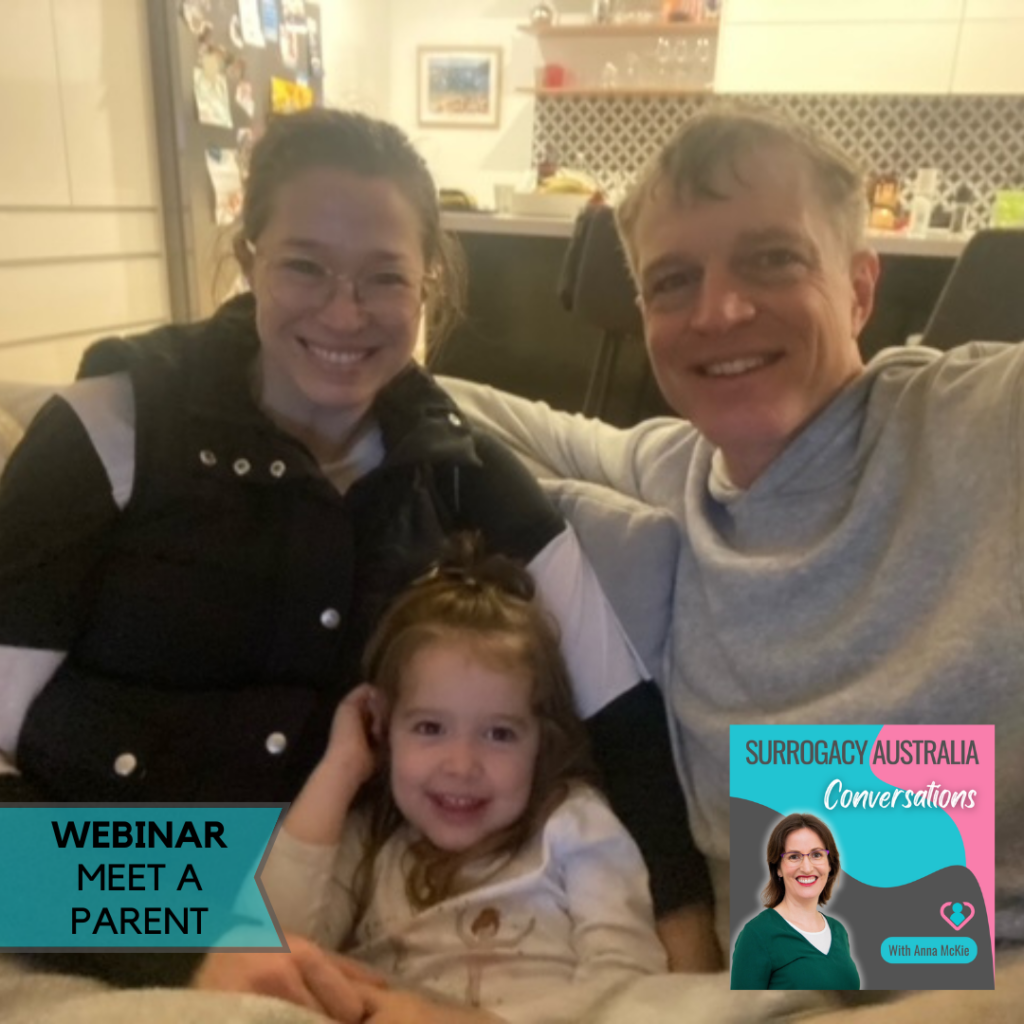
So we’re joined by Kate now. And as I said in the introduction, it’s a slightly different webinar tonight and a different story, which is really valuable for the community to hear. So just a couple of photos here to give you a visual of Kate and her family. So Kate, tell me who we’ve got in this photo. This is me and my daughter Harriet just a couple of months ago, actually.
02:18
performance of the Gruffalo in Melbourne. The Gruffalo, what a winner. Big smile on her face there. And then one extra person in this photo. This is my husband James. So that was us, I don’t know, sometime beginning of winter, I think this year in our home. And Harriet, think looks like she’s wearing pyjamas. So right before bed probably. Yes. I wasn’t quite sure of the order of these photos, but it sounds like they’re fairly close. Yeah. Yeah. This is all, you know, this year.
02:42
Three and a half, I think you said to me, Harriet is. She was born April 2019. So I’m pretty pandemic, thankfully. Yes, right. That would have been quite different, but therefore you had a one year old. Yeah. Yeah. that also meant then that the journey that we’re going to hear about then.
02:58
going through all of that was during quite a bit of lockdown. right. Our surrogate lived in Bendigo, so it still does. We sort of managed to dodge, we sort of were coming up and down between the lockdowns and trying to negotiate like medical treatments. Anyway, it was complicated. Yes. And surrogacy is a lot about that, isn’t it? Juggling logistics of things. Yeah, absolutely. navigating people’s schedules and lockdowns in your case.
03:24
Yeah, for sure. Particularly because, I mean, oftentimes the surrogate will have her own children, so she’ll have her own school pickups to do and her own, you know, time that she doesn’t have available. So yeah, it’s juggle. Absolute juggle. Yes. I’d imagine that you became the queen of logistics of navigating all of that. That project management, I suppose. Yeah. Yeah. And we were lucky in that our surrogate is one of the world’s most organised people. So she was heavily involved in making sure that everything ran smoothly.
03:51
We’re both pretty organised people actually, as it often does, I think that that side of it kind of fell to us in the end. Yeah, but it’s good if the surrogate’s on board too and, you know, sorting appointments out and helping things happen. But I think you do find in IP couples, be they a straight or gay couple, one person does become the project manager. it shouldn’t be underestimated. It’s quite a, there’s an emotional toll to it, but there’s also just an administrative load.
04:16
with making all the appointments paying as the internet parent. Obviously we were paying for all the appointments, managing the budget, managing her, Jess’s expenses, our surrogates expenses. And I mean, because it was COVID actually a lot of it was done over Zoom. So the counselling sessions, all of the legal consultations were done over Zoom. As much as possible, Jess did her blood tests and her other medical tests locally. So in a way COVID kind of helped, they gave us more leeway to do that kind of thing.
04:41
Yes, indeed. That kind of underestimate the toll that that can take. I’ve sometimes said to people, I think it’s another part-time job. just the appointments, but even the relationship element with your surrogate checking in how they’re going and making sure they don’t just feel as transactional all those appointments. It’s true. You know, the IVF aspect as well. I mean, we probably go into this in a minute, but um getting the embryos made, making sure, you know, discussing it was important to us. We needed to make sure that we were on the same page about how long we were going to try this for.
05:09
We also, I think, just needed to make sure Jess understood that this was her show. Like she got to choose if it happened, how many times she wanted to do it, you know, all of the decisions about where the baby would be born, how the pregnancy would go, all of that stuff. just, it was important to us to make sure that she was in charge. But you know, it’s a big thing to do. Like particularly with my experience, you know, the birth of my daughter was an absolute no. It pretty much went as badly as it could go without.
05:37
actually losing anyone. So, you know, you’re asking someone to put their life at risk. It’s a big deal. That’s true. So because you’d had a birth like that.
05:45
wrong. So you know what you’re asking. So maybe there’s a good spot. So take us back to that’s probably why you’ve needed a surrogate after Harriet’s birth. So talk us through a bit of that. Yeah, sure. I mean, it’s a long and sort of pretty depressing story, to be honest. I had uterine fibroids, various operations to get rid of them so I could get pregnant. All of them went fairly smoothly, but there was some scar tissue left in the uterus, which meant I had full placenta previa, which is where the placenta sits right over the cervix.
06:13
So, planned Caesar and usually quite a lot of bed rest towards the end. So I was in hospital for a month before she was born because obviously if the placenta comes out, it’s curtains for everybody. That was obviously not ideal, but know, planned Caesar, usually things in these situations go pretty smoothly. People go on to have other children. But in my case, the placenta had grown into the uterus. So placenta accretum is what that’s called. And so they had to take out the uterus to stop the bleeding and kind of just went from there really.
06:39
So we knew straight away that that was it for biological children that I could carry. Jess, my sister-in-law, Jimmy’s my husband’s sister, offered pretty much straight away. In fact, she’d offered even before we got pregnant with Harriet because I’d had to have all this other surgery, that if it for whatever reason didn’t work out, she’d be happy to step in. And she had already had two boys, they’re now 13 and 11. So we spoke after kind of the first year of, I mean, I think when we first had Harriet, we were sort of like, oh God, I’m never doing this again.
07:08
But after that dust had settled, we decided to give it a shot. because she was still is a family member, that part was super simple of finding the surrogate. We really wanted Harriet to have a playmate. I’m one of two. My
07:23
husband is one of three, we wanted her to have the same sort of growing up experience that we did with playmates and you know, fighting and also I think we were just so touched that Jess offered. think we were talking earlier about how that’s just, it really is the best of family that somebody would be willing to do that for you. Not only because they’re doing it out of love, but also because it’s an endorsement of your parenting. They’re sort of, she’s sort of saying, yeah, well you guys are doing an okay job. keep doing happy to help you with another one and see you keep doing more. Yeah. And I think that’s a good point for people to remember that, okay, yes, in your case, some
07:53
offered and they came forward. But it’s good for people because you know we’ve obviously got some gay guys listening here that to keep talking to people about your need for a surrogate and just you know even saying oh yes no we’ve attended this webinar or whatever but so that they know that surrogacy is your path and then they might offer or they might have been thinking about it so as you said it sounded like Jess already knew of some of your troubles and she’s
08:14
having been a pregnant woman is going, this isn’t going so well. I wonder. And so she wanted, you know, particularly post-birth there for you, dealing with trauma. You know, you’ve got a newborn to look after and now you’re going through a grief that you can no longer carry anymore yourself. so Jess would have been quite aware of that, I’d imagine. Yes, definitely. But I mean, even though she’d offered multiple times, it still wasn’t easy to bring it up because in end, she’d said it multiple times, I’m happy to do this for you. You just let me know what you’re thinking. And, but then we had to actually say to her, so,
08:44
We’re kind of thinking we might want to do this. And that took like a week to get the courage up to sort of say, are you serious? I mean, it was because it was also in pandemic, right? So the whole thing was not proceeding as as normal life. So I would obviously I’m so glad we did it. And even though the result wasn’t what we hoped for, it’s changed our relationship forever. I would never not do it. I would never go back and change anything. And that closeness will always be there. So then so she offered and so then she’s offered a few times.
09:14
but then you got brave and asked, so we’re now into 2020 and Harriet’s won? No, we’re now into 2021. So asked her in, so Harriet was born 2019 and we asked her in 2020. In 2020, yep. And then they actually went on this like really long trip around Australia. So the agreement was that we would actually get started once she came back. Sure. And so by getting started, did that mean creating embryos and doing counseling and legals? Is that what that means? Good question. I’m 38, I was 37 then, I was 36 then.
09:41
So I was… could create the embryos while she was up on so I thought, right, well, let’s… I still have my ovaries. I thought, well, let’s get this going. I’m not getting any younger. So we created the embryos while they were awake. Yep. And we ended up with four, five embryos. We put them all on ice. And then when she came back, we began making appointments with lawyers, getting all of her medical checks done. We knew that they… It sort of worked quite well because obviously there’s the quarantine period for the embryo. So that was all done and dusted by the time she got back. And she was kind of, you know, she had some time off, she was ready to go. Yeah. So went through Sarah Jefford.
10:10
who’s an extremely experienced surrogacy lawyer, fantastic, I would recommend her to anyone. I listened to a lot of podcasts and particularly the Surrogacy Australia podcast, not just about understanding the process that we had to go through, but the emotional impact. It’s a hugely emotional thing. I wanted to understand better how to take care of her, what she would be feeling. There’s the fact that, you know, she’s a family member, but she’s not my blood family. So you just feel like you’re asking this huge amount of someone. Yeah, and just, I didn’t know anything about it. I didn’t know anything about…
10:38
the handover process worked if there was a baby or who makes decisions about things like amniocentesis and having been pregnant before I’d kind of been through all of that stuff with James and you know what decisions we would make in certain situations and we needed to go through that with her as well. Yes and everybody having a rough plan of how they feel or the decisions they’d make but then also saying but we all might change our minds when we get to a certain situation and building in flexibility and things there so yeah these are very considered children aren’t they the fact that we all go through all this counseling and we
11:07
think about all of so many of these scenarios that could happen in pregnancy and birth and what life will look like after in terms of surrogates not wanting to parent your child but wanting to be involved. It would be in some ways be greater than so many other people before having children and to go through some sort of thought process. So as a team you were going through that later 2020, started 21 now and when did you your first embryo transfer? The first embryo transfer was towards the end of 2021, I think it was about August, about a year ago now.
11:35
Yeah. I should mention as well that on the financial side and forgive me if you’ve already mentioned this, don’t think you did. Not tonight. Medicare rebates in reply if you’re doing surrogacy. We’re trying to, I’m actually with Surrogacy Australia, we’re trying to change that. But for now, federally, you know, you’re out of pocket the full whack. So the other thing I would say is clinics can, IVF clinics can sometimes be a bit confused by the surrogacy thing. It’s not common.
11:59
You not all of them have done it. things like whether or not to get the embryo tested genetically, that’s something I wish we had done. It’s not common practice, but I think that’s something that we probably would do, we would have done differently thinking again. If we knew at the beginning that we only had one genetically normal embryo, we probably would have gone back and done it. Yes. Which is interesting because different states might recommend things differently because in South Australia, I think it kind of was pushed in some ways with our clinic.
12:25
But then they’re expensive every time too, to have things tested and at what point you test and is it better to test the lot at the beginning and then freeze because every time you defrost and test, you run risks.
12:35
issues happening. do you get Medicare rebates though if you do it under fertility preservation? If you’re not the one carrying the baby you don’t get the rebate. And so that’s true, so it sounds like your IVF clinic were actually very above board because they knew you didn’t have a uterus so there was no home for the eggs to go to therefore they charged you full price. Yeah look I think actually what happened, this is to my point about them not being particularly experienced, so was a big you know.
13:01
Melbourne fertility IVF clinic, they hadn’t really, they’d done surrogacy maybe once or twice before. And that they sort of tried to fudge the system, but as soon as the administration staff figured out that I wasn’t the one carrying the baby, they immediately kind of nipped that in the bud. So there wasn’t a lot of communication, one hand wasn’t communicating with the other. And so certainly if you’re two guys that rock up to a clinic. And so Kate’s joined the board with Surrogacy Australia and that’s something, you know, we’re passionate about changing.
13:27
because it’s uh an extra unfairness of surrogacy is already so expensive for people. If people have specific questions about costs, type them in if that’s the things that you want to know. So we got up to doing some embryo transfers. I mean, is there anything else you needed to add about the counseling and legal process? Really, that part of it was actually pretty smooth. I mean, the clinic recommended the counselor. uh She was wonderful.
13:48
We both had lawyers that we liked who made life pretty easy because we fit the criteria so exactly. The patient review panel was slightly intimidating, but actually they weren’t nearly as scary as I thought they would be. And it was, that was pretty smooth. We were approved straight away. think we heard back like the next day or was even that day, I think they said yes.
14:06
Yeah. Good. Yes, because that’s the extra step you have in Victoria, having that extra panel there. So that’s good. Then you began transfers. We often just get lazy and we don’t call it emergency transfers, do we? We just say transfers. And so the tracking of bloods that Jess was doing and so having to fit that in around school drop-offs because often I’d have to do blood tests in the morning. she logistically did that. Did you do back to back months? We did. We did three months, then we waited for Christmas and then we did the last one.
14:33
We only got three in the end because one of the embryos we lost in the thaw. Same. Yeah. And that’s hard because you track the whole cycle, you know, up to that point and then yeah, then it doesn’t work. And so that’s hard for everyone. Did any of them get a little bit pregnant? Yes, we had one chemical pregnancy. That was probably the hardest thing actually. He just rang and said, this is definitely it. Yes, right. I can feel it like this is it. And then two weeks later it was gone. That was ah
14:56
Yep. And so then what was it like coming into that last embryo transfer? Did you have to start the chats about what the plan was going to be? We spoke to Jess about it. I mean, she wasn’t that keen to keep going if the last one didn’t work and made that kindly and firmly clear. Yeah. Partly because of all the travel and partly because, know, it’s hard. You can’t make plans. You can’t sort of your whole life is on hold until you know whether or not you’re going to be pregnant for nine months. it’s just the month after month of should I be drinking this? Should I be eating this? What, you know.
15:25
Also, I think, you know, my husband and I pretty tired. I’d had all those operations, then the pregnancy, then a high risk pregnancy, and then what happened with the birth and then the surrogacy, you know, seven years it took in the end.
15:37
to get to where we were and it was just you have to at some point say well our option now is to try to make more embryos possibly need an egg donor because I’m getting older and and because of the hysterectomy that egg quality is declining pretty quickly. We’d have to go to the States probably or overseas just to expedite the process to try to keep the age gap small enough that
15:58
Harriet and her sibling would be kind of playmates. And we just decided it was time to let go. It was not an easy decision. It was incredibly hard, but it led us to examine the reasons why we wanted to do it in the first place. And that was about wanting Harriet to experience living and playing with another kid. also about just, you know, one sort of has a feeling of what their family is supposed to look like. I’m one of two, so of
16:22
I should have two as well. There were various things that made it easier. The first was that we felt we really did do everything we could. The second was it gave me the opportunity to really consider the benefits of an only child and there are lots particularly for women who want to work. And I guess, you know, just reading about what it’s like to be an only child and how it isn’t necessarily the, some of the stigma that surrounds it, it’s really just not true and to educate myself about that was helpful.
16:47
But it’s grief, know, it’s like any bereavement. just, it gets easier with time, but never really goes away. then, but yeah, like as I said, examining the reasons why we wanted to do it led us down a different path, which is probably we’ll look at fostering in a year or so when she is at school, start school, em when she’s old enough to kind of have a say in the whole process. So it opens other doors, even if it closes one door. Yeah. Thank you for sharing that journey with us. So as you say, has helped you reflect on.
17:15
what it is you want out of parenting and for your child too. So that’s, you’ve found your silver lining, I suppose, in some ways to having that next thing to look on. When you said it’s a grief process to work through, so that was at the start of this year then, wasn’t it? Did yourself or surrogate Jess have any outside counselling or did you lean on other sorts of support networks to come to that decision? We didn’t, we had.
17:40
done a lot of mental health work after Harriet was born. And so I sort of had tools already to deal with it. Jess was fine. I think she felt that she’d done the best she could. she said, if we didn’t have Harriet, it might’ve been different. But the fact that we already have a child and she’s great. And there’s also an element of just trying to be grateful for what you have, particularly when, you know, both of us almost didn’t make it. You just sort of think, well, I think we should just stop constantly asking for more.
18:10
it makes you grateful when you realise how hard it is and how often it doesn’t work. Like it makes you grateful for what you have for sure. Yes. And that’s tricky, isn’t it? Because you’re allowed to want what you want. know, people listening either tonight or to the recording, they’ll all come at it from different perspectives. Some will be IPs listening who already do have a child or two and they’re going, we want a third one to complete our family. That feels right for us and that’s okay. And then for other couples too, who are right at the beginning, might be two guys and…
18:37
wanting what they want to, it’s okay. But I think sort of what you’re saying with your own mental health work as well, it’s that ability to continue to reflect and going, what are my motivators here at each step in the way? And when do we call it a day too? Because these things get quite expensive. They’re probably healthy conversations to have as a couple too. I’m wondering if that’s any advice you would give to people in terms of- Oh, definitely. It’s like if you’re at a house auction and you’re like, how far do we go in this? If you haven’t already, as you said, if you haven’t had Harriet, then Jess might’ve kept going and then-
19:06
how many tens of thousands do we keep pouring into this? To the point earlier, think mental health help along this journey is so…
19:13
so useful. And it doesn’t necessarily have to wait until you’re feeling desperate or lost hope or when you’re feeling terrible. That’s not the time to get mental health help. The time to get mental health help is almost a preventative thing. know, it’s going to be hard at times, it’s going to be disappointing at times. You know, maybe you’ll have this unicorn experience, but probably not. And it’s not a bad idea to investigate sort of who you might be comfortable talking to and get a support network around you for when it does get tough. I already had a psychiatrist that I was seeing after that I needed to
19:43
see that they sort of set me up with after the traumatic birth and I’ve used her a little bit through the process and afterwards. And that was great because you can just kind of reinforce the tools that you already have. The other thing I would say is that your relationship with
19:55
you’re doing it with a partner, then as an intended parent, then I think the relationship with the partner, you’ve just got to keep communicating with each other because you can get frustrated and cranky and it’s expensive and hard and it’s, you make compromises and yeah, it’s just really important to keep that relationship as positive as possible because you’re in it together, know. Good advice. And so yeah, the couples that go through these sorts of things are quite strong if they can’t come through it, I would imagine, because you have to keep being. Yeah. Yeah. You have to work as a team. Definitely. So people listening tonight, you haven’t typed in any questions,
20:25
yet that I can see. So feel free to be brave. No questions off limits for us. If you want to ask Kate a specific question about her journey or if you’ve got very general questions about anything about surrogacy in Australia that we haven’t covered tonight, be brave. We’ll hang around for a little bit longer and answer your questions if you’ve got them. I suppose, you know, while they’re typing them in then Kate, is there something significant that you’ve learned about yourself having gone through this journey? oh
20:48
That’s a good question. Yeah, I guess, yes, that if even things that you think you’re not going to be able to manage or survive, you can because you just have to. And hope can come from the most surprising places. Like I would never have envisaged myself fostering children. I think we’d be really good at it because we’ve come from a place of desperation. know, we’ve we’ve been through, mean, I’ve never.
21:09
been through the kind of family situation that removed me from my parents. But I do understand a little bit about what it means to be disappointed and grief, you know? And so I understand what it is to be traumatized to some extent, different kind of trauma, but it’s totally changed my perspective. You get something out of it no matter what.
21:25
Yeah, that’s powerful, powerful lessons there. Is there anything about the journey that you did go on with Jess that you would change? Obviously end with a baby would be perfect, you know? in terms of reflections for people, you know, listening in tonight that might go through their own surrogacy journey, is there anything about the process that you’d do differently? Don’t do it in pandemic. Okay, good.
21:46
No, actually, I wouldn’t. It was super, super great. It was well organized. It was easy. I would do the genetic testing this time, but that wasn’t anything to do with her. No, I wouldn’t change a thing. was, it’s just, you just chip away at it. It’s one step at a time. It’s one appointment and then the next appointment and the next appointment. just. Yes. Yeah. Cool. All right. That’s good advice too. We have a question. We have an anonymous question, so I’ll read it out and.
22:08
we’ll see what it is and you might be an answer for us. So it says in the slides at the beginning, it was mentioned medical rebate would cover the costs as if the parents were doing the cycle. However, Kate’s experience states otherwise. So can you, we get some.
22:19
clarification on that please, especially that we’re in Melbourne, same as you. Okay, so there’s a few stages, right? So the first thing you’re trying to do is create the embryos. I’ve never done it with a donor egg, with my own, but if you are using, if you’re creating embryos, like even your partner to be used in somebody else, some IVF clinics will try to fudge it and say that you’re doing it to preserve fertility. Yes. But it’s actually quite hard to do this without mentioning surrogacy at any time. And also if you have had a hysterectomy, that’s why you’re there. jig is up. that element of it,
22:49
sort of luck of the bit, it’s illegal. you, and they get in serious trouble if revealed that they have been giving Medicare rebates to people making embryos for C-C. But some clinics will do it, didn’t. In Queensland, doesn’t life fertility do it?
23:03
Yeah, they do. Actually, Sarah Jeff had mentioned that to us earlier in Queensland. But I’m not sure if that’s Brisbane law is slightly different or I had this feeling that they found a loophole or something or it was always going on a fertility preservation. I’m not sure. It’s a good question. I mean, I’m not sure about Queensland. Certainly in our experience, there was no option. And then once you do the transfers again, clearly it’s not your body being
23:26
having the embryo trans. Yes, because the person having the treatment is not the plain people. Anonymous, I think we sort of answered that. So just to absolutely clarify, if you’re at the very beginning of your journey and so just getting your head around all this IVF world, I guess if I needed a surrogate after having been one, but what would my reasons be for needing a surrogate? Perhaps it’s scarring in my uterus and perhaps I tried to get pregnant, but I couldn’t hold the pregnancy or perhaps there had been cancer or some people that have had say transplants because of the medication.
23:56
that they’re on, it means they can’t hold a pregnancy to term. Yes, it means I could still get pregnant and so if I went in…
24:03
trying to collect my eggs to make them. Right. Then the clinic could go, oh yes, you have a uterus to put them into, we’ll collect your eggs with that plan. Then suddenly once you’ve got the eggs, made them into embryos, they go, oh no, no, now we changed the plan. Oh, you are going to use the sorghum. And so for the people that I donated eggs to that were also for sorghum seed, that’s what happened. Cause you could turn the blind eye and pretend it was going to go back into the intended mother. But yeah, if you’re using your own gametes, your own egg and sperm, then you’re kind of stuck.
24:32
Yeah. Just as a side thing, this is the type of stuff that surrogacy Australia are involved in with our board. We contribute to law reform in each state. So whenever they go through reviews, often they come to us to contribute. And these are the types of things that we’re getting worked into the changes in each state. So that’s why I feel like South Australia, when we did ours a couple of years ago, I feel like that got changed. Federally, there is no provision for surrogacy for those Medicaid benefits scheme codes. Yeah. It’s a hangover from a time when IVF was legal, but surrogacy wasn’t, or it wasn’t. mean, traditional surrogacy has happened for centuries, right?
25:02
altruistic gestational. Right, through the clinics. And so it’s trying to be equitable. so making the eggs collections, look, sometimes you can get Medicare rebate, but the moment you do an embryo transfer into a surrogate, that is full price. Whereas if you put an embryo into another normal woman, even if it’s donor eggs, but it’s into the person, suddenly they get Medicare rebate. And that is unfair. And that is something that Kate’s very passionate about changing because surrogacy is already so expensive. And you know, this is the only way these people can have a family. So it fits the Medicare laws.
25:32
in our mind.
25:33
Yeah. Well, there is one here. Can embryos created outside Australia be used in Australia? In chat? I hadn’t looked at that. Thank you. So I’ve got a rough idea of the answer. Have you? No, I don’t know because we never had to go down that path. Short answer, yes. But you would need to check the legalities of each state. For example, well, no, I do know of uh one of our SAS mentors. They, two guys, they went through the World Egg Bank. That’s totally anonymous. Although in Australia, not only do we encourage no end donors, but I think some of the clinics are particular about
26:03
having a known donor. But I think there’s a slight difference to being completely anonymous versus identity release at 18. And I think that’s where the World Egg Bank might come into play is that it’s not completely anonymous. do have access to that donor down the track or something. And so that might tick the boxes. But I do know in most states, because I’ve asked surrogacy teams in each state who have used overseas
26:24
donors, yes, they’ve been used. So I hope that helps. But that’s a great question for your clinic. And ideally somebody at your clinic who has specific knowledge in surrogacy, because those tight little questions not everybody will know. So now I’ve gone back to the chat and so just
26:37
looking at what’s here. So people are saying, thank you, Kate, for sharing and answering the questions. Oh, they’re just saying that brought up things that they hadn’t considered. So that’s always helpful. mosaic embryo, can that be transferred into a surrogate? There might be some people tonight that don’t know about a mosaic embryo. Kate, are you able to give us a what’s a mosaic embryo? A mosaic embryo is a genetically abnormal embryo that does have a very small chance of resolving into a viable pregnancy. A genetically normal embryo is a euploid embryo and a mosaic embryo has a much lower chance of being a viable pregnancy, but it can happen.
27:07
The mosaic embryo, can it be transferred into the surrogate? I think that’s probably a question. I don’t think that there’s a hard and fast rule about that. It’s going to be up to your clinic, your doctor, you and your surrogate as to whether you want to implant a mosaic embryo. Agreed. So the answer is yes, it can be, but you’ve got to bear in mind that could start with a pregnancy, but then at 10 weeks that miscarries and then the surrogate might need to have
27:30
they call a DNC to remove that pregnancy. So she has to go through that. That can be traumatic, can be smooth and so that might have an impact. yes, you can, but I think Kate’s suggestion there about chatting with the team of doctors and your surrogate, these are all things you should probably talk about.
27:45
way before you can get pregnant. You know, these are the list of things that you should chat through to see how everybody feels. But then of course, revisit all these questions once you get closer to the time and things can change. And the surrogate might say right at the beginning, yes, happy to do it. And then once she’s already had two or three transfers, she might say, no, I can’t, I’m done, I’m spent, I’m worn out. And so things can change, can’t they? Yes. But some good questions there. So it’s some nice specific ones there to some individual circumstances. I think we’ve pretty much covered it tonight.
28:13
Have you got any sort of like last minute parting words or advice to those listening? Just good luck. Thanks everyone. It’s yeah, I hope you will end up with the outcome you’re hoping for. Yes, and learn lots about themselves along the way and keep talking to each other. And yeah, it’s some good advice there you said about even in your own relationship to making sure that’s solid. Yeah, definitely. Thank you for joining me. If you’d like to see the photos shared in this webinar presentation, head over to our YouTube channel to watch the webinar.
28:42
You can head to surrogacyaustralia.org for more information about surrogacy. Also check out our Zoom monthly catch-up sessions, which are a great way to connect with others in the surrogacy community. Attending a Zoom is scary the first time, but there’s only ever one first time. We have all been beginners at some stage. As we say, it takes a village to raise a child, and in the case of surrogacy, it takes a village to make a child. So welcome to the village.
Looking to find a surrogate in Australia? Consider joining SASS.
Looking for an overview of surrogacy? Join us in a free, fortnightly Wednesday night webinar.
Looking to chat with other IPs and surrogates in a casual setting? Join us for a monthly Zoom catch up, one Friday of each month.
Looking to hear stories from parents through surrogacy and surrogates? Listen to our podcast series or watch episodes on our YouTube channel.
Looking for support one-on-one? Register for SASS to connect with me – your Siri for Surrogacy, or book in for a private consultation sass@surrogacyaustralia.org