.
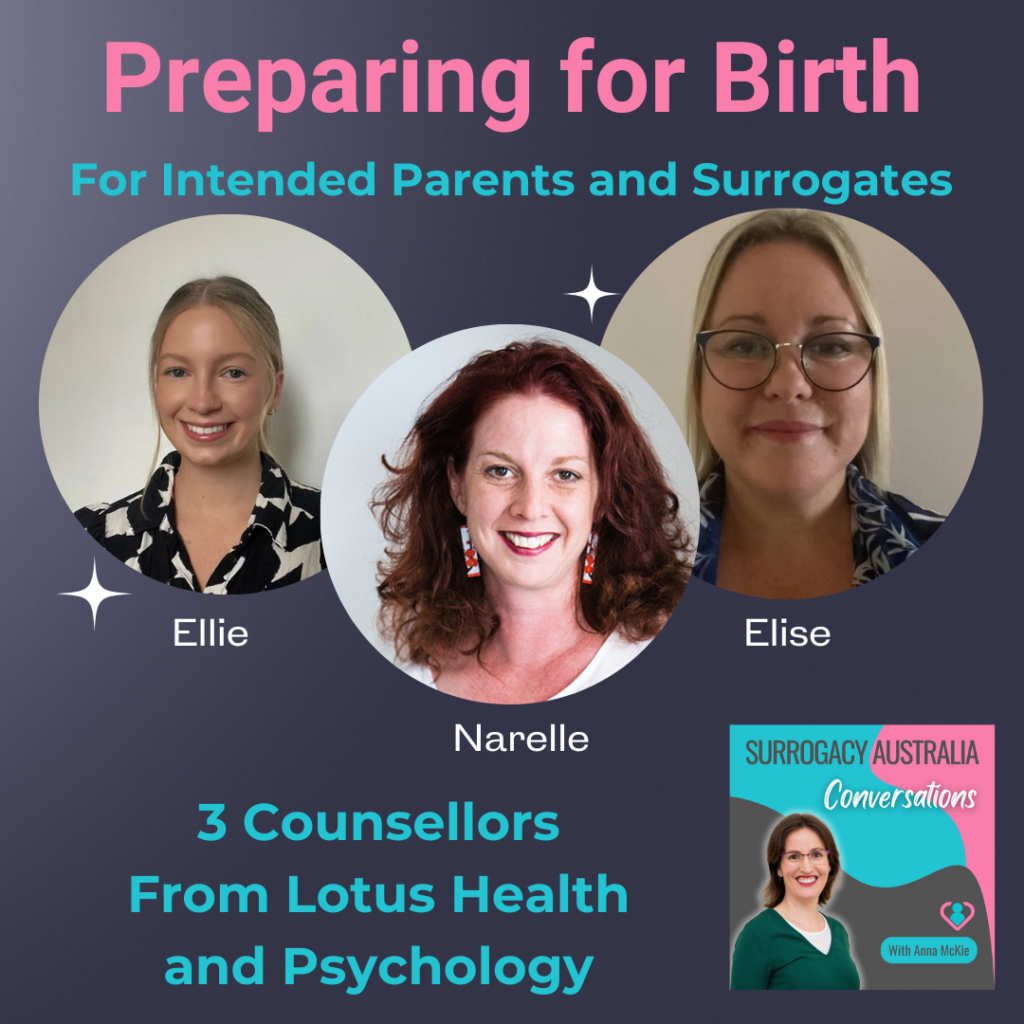
Episode 160 – Preparing for Birth – 3 Counsellors
On the topic of: Preparing for Birth
Guests: Narelle, Ellie, Elise
3 Counsellors guide us through what to expect for Intended Parents and Surrogates when planning for birth.
If you’d like to arrange your own session with Narelle, Ellie or Elise, you can find them at Lotus Health and Psychology.
Watch it on our YouTube channel.
.
These podcasts were recorded as part of the free webinar series run by Surrogacy Australia. If you would like to attend one, head to this page for dates and registration links. The recording can also be found on our YouTube channel so you can see the photos that are described. Find more podcast episodes here.
The webinars are hosted by Anna McKie who is a gestational surrogate, high school Math teacher and surrogacy educator working with Surrogacy Australia and running SASS (Surrogacy Australia’s Support Service).
Follow Surrogacy Australia on Instagram, Facebook and YouTube.
Are you an Intended Parent (IP) who is looking to find a surrogate, or a surrogate looking for Intended Parents? Join SASS.
00:00
you
00:14
Welcome to our podcast series with Surrogacy Australia. Thank you so much for taking the time to listen and in turn for helping us spread awareness and appreciation for surrogacy. I’m your host Anna McKay and these recordings are from a regular webinar series that I run. You can find upcoming dates on our website at surrogacyaustralia.org. During the one hour webinars I will walk you through the surrogacy process in Australia and you can type in questions for us to answer.
00:41
My co-hosts have all done surrogacy in Australia and they alternate between surrogates, gay dads and straight mums. This episode, recorded in July 2026, is slightly different to our standard webinar series as it involved three co-hosts, Narelle, Ellie and Elise, who are psychologists and psychotherapists and have supported many surrogacy teams through their journeys.
01:05
Narelle has joined me on previous webinars and those recordings are episode 30 where we discussed her research into traditional surrogacy and episode 55 discussing the different stages of counselling in surrogacy. My dream when I coordinate groups of guests like these is so that this recording could be of use to future surrogacy teams and perhaps even psychologists who are new to surrogacy. If you listen to this episode and it is of help to you, please send me a message and let me know.
01:34
If you’d like to arrange your own session with Narelle, Ellie or Elise, you can find them on their website, Lotus Health and Psychology in Brisbane. In this episode, we mentioned SASS, which is Surrogacy Australia’s support service, which I manage. If you’re looking for more individualised support, to be connected with a mentor and as IPs, intended parents, to be potentially connected with a surrogate, head to Surrogacy Australia’s website to register. SASS is also open to teams who know each other before surrogacy.
02:03
and they were joined for the mentorship, agency support for the IPs and surrogate, and to have me as your guide. You might think of me as your Siri for surrogacy, or as someone else from our community, our village called me recently, your ChatGPT. I hope you enjoy this episode and please reach out to myself or the team at Lotus if you have further questions.
02:24
Hello and welcome to Surrogacy Australia’s webinar. My name is Anna McKay and I gave birth as an altruistic surrogate in September 2020. I’d like to acknowledge the traditional custodians of the land upon which we are recording, listening and living on and pay my respects to elders past, present and emerging. I’ll do a few bits of housekeeping in a minute, but let me introduce my three co-hosts. So, Narelle first of all.
02:46
they’re all Brisbane based because they all work part of the same group, Lotus Health and Psychology. So Narelle is an Zika accredited clinical and health psychologist specializing in the perinatal field and many years of experience of surrogacy cases. She’s completed a Churchill Fellowship which took her around the world to study surrogacy practice in the USA, Canada, Russia, Southeast Asia. At her practice, Lotus Health and Psychology, Narelle leads a team of expertly trained perinatal specialists to support people through preconception, pregnancy, and inter-perinatal
03:16
And so speaking of that team, we’ve got Ellie and Elise with us tonight. So let me tell you a bit about those. Ellie is a clinical psychologist with a particular interest in fertility, donor conception, and surrogacy counseling. She works with intended parents, surrogates, donors, and recipients across all stages of the surrogacy journey, including implications counseling, pregnancy support, birth preparation, and adjusting during postpartum.
03:39
Elise has 15 years experience in the fertility sector in both private and public health fertility clinic settings and also with her own private practice. Elise is an experienced counselor and psychotherapist whose primary practice focuses on fertility related counseling. Elise is also an accredited clinical supervisor providing guidance and support to practitioners working with fertility and relationship related concerns and difficulties. So welcome ladies, thank you all for joining us tonight. Thanks for having us.
04:08
Right, and it’s worth mentioning that um you can book in with these ladies for your own session if you want to at any point in time. It doesn’t matter what state you’re in. I’m putting the link for Lotus in our chat so you can access that there. Lotus Health and Psychology, you can Google that as well. I’ll just do a few little bits of housekeeping and say that I run these webinars regularly on a Wednesday night starting at 8 p.m. Sydney time. They alternate between having a focus for IPs, intended parents, and surrogates. I’m also joined by a co-host each time
04:38
is either a surrogate or a parent through surrogacy, be that a gay dad or a straight mum, or sometimes we run these themed episodes where we have guests on, sometimes doctors, lawyers, counsellors, or partners of surrogates, children, mothers of surrogates we’ve had on too. So there’ll be opportunities to ask questions so you can enter them in the Q &A box that you’ll find.
04:55
at the edge of your screen somewhere. You can choose for those questions to be anonymous if you prefer. As I’ve also said, there’s a chat section too. I’ll keep my eye on the questions and so either sort of weave them in if we’re talking about them at that moment in time or we’ll sort of save them to the end and collate them if necessary. Now in terms of who I anticipate might be here with us tonight, you might be IPs who are new to surrogacy and you’re looking for a surrogate. You might have formed a team or you might be heavily pregnant as a surrogacy team. You might be a surrogate who’s with us and you are new or experienced but welcome
05:25
to everybody that’s joining us. Alright ladies, well there’s the housekeeping. I’ll just also say people are welcome to leave the webinar at any point in time but we’ll hang around for about that 45 hour mark. So Narelle, start us off. Preparing for birth as a surrogacy team, tell us some of the things that we should discuss and consider. Thanks Anna. I think we’re all going to contribute tonight which is really cool. I think I’m so thrilled to have my team online with me. But I guess what we’re going to talk about is that when people are exploring surrogacy they tend to be pretty focused on getting pregnant and bringing the baby.
05:55
home which is understandable but there’s a lot to do first. There’s medical processes, legal processes, counselling, screening, pregnancy birth plans, hospital arrangements, lots to do. But we tend to do a little bit less planning about what’s going to happen after the baby’s born. A lot of intended parents do expect that they’re going to remain close to their surrogate forever and most surrogates probably imagine being an ongoing special
06:18
part of the child’s life. And sometimes all of that goes exactly as planned. And sometimes relationships become even stronger as a result of the surrogacy. But sometimes people find themselves in a reality that’s a bit different from what they expected. I keep hearing that people perceive the pre and post counseling as being something that they just have to get through and it kind of rubber stamps the surrogacy process. And I’ve even been told that you should cover up anything you don’t want the counselor to hear. The reality is
06:46
you won’t get very much from the process if you do that. And our job as in the pre-surrogacy counselling is actually to help you plan for a successful surrogacy and avoid potential pitfalls and problems. Some people will keep on accessing counselling through the pregnancy.
07:00
to keep the planning moving and avoid any communication hiccups. And after the baby’s born, most states require that you undergo another round of mandated counselling, which does meet some of the specific legal requirements, but also helps ensure that the surrogacy team stays on track. Tonight, we’re going to start by explaining a bit more about what post-surrogacy is and how it can help intended parents, as well as surrogates and their partners, continue to adjust to the emotional and relational transition that follows the birth. And we hope that
07:30
the end of this, counselling won’t just feel like a rubber stamping process anymore. So I’m going to ask Ellie if you could help us understand a bit more about what post-surrogacy counselling is. sure, thank you Narelle. This is probably one of the biggest questions I get from IPs and surrogacy , you know, why do we have to come back and talk and do more counselling and it’s a really good and valid question I think.
07:55
But guess from the counselling perspective, the way I look at it is, know, birth isn’t where the psychological work finishes. We’re coming into such a massive transition and it’s a completely new stage of the journey. So that’s where the counselling really comes in. So I guess one of the things we know in psychology is major life changes don’t just change what we do, but they change the way we relate to each other.
08:19
know, overnight we step into new roles, intended parents become parents, Sarah gets no longer pregnant after months of carrying a child for another family, partners children also adjusting too. So we’ve all gone through a really similar experience, but we’re all each moving into different next chapter.
08:39
So when we meet people after birth, we’re not looking for problems as you’ve highlighted there, Narelle. We’re not trying to fish that out, so please don’t hide it from us. We’re really just trying to help people make sense of such a significant change. I guess what that can look like is sometimes it’s a big celebration of lot of positivity, reflecting back and looking at what we’re proud of.
09:03
Sometimes it’s making sense and space for unexpected emotions. Sometimes it’s simply just being able to pause finally and reflect on the experience we’ve been through with so many different lens points. So I guess that’s really what that space is for. It’s an opportunity for all of those perspectives.
09:22
You mentioned briefly there, Narelle, meeting in the third trimester, we found, has been really beneficial for a lot of people. guess early on, it’s a lot of discussions of, this right? As things progress, it’s, you know, what’s birth going to look like? How are we going to support each other? And those sort of questions come up. So there’s some very different conversations that happen between the start and coming towards the birth and having that opportunity post-birth to chat. Let it all sink in is
09:52
So, so important. There are some things to know about what’s mandatory in terms of counselling. I won’t bore you all to death and give you the whole spiel of how it works everywhere, but it does differ quite a lot across Australia. to summarise really succinctly, Queensland, Tassie, Western Australia, Northern Territory.
10:14
have relatively similar requirements. They require pre and post-surrogacy counselling that’s mandated. New South Wales is very similar. They have some extra nuances in needing relinquishment counselling additionally. Victoria, South Australia and ACT are a little bit different as well. There’s much more emphasis on the pre-surrogacy counselling and the mandatory aspect of post-surrogacy counselling is not there.
10:43
There’s differences. I guess my point really isn’t in remembering what the legislation is wherever you are, but it just does differ across the board and it does depend on where your journey is taking place. So I guess, regardless of the requirements, counselling throughout this journey is about supporting people through some very different tasks and that post-surrogacy counselling is really about helping everyone make sense of it all in the aftermath.
11:11
Yeah, I guess I’ll pass back to you, Narelle. I hope that gives a really nice synopsis. I could probably speak endlessly on what we talk about in post-surrogacy , but that’s a little snapshot. Yeah, thanks, Ellie. And I think the legislative differences is something that
11:26
does the head-in for a lot of people. It does for me as well, trying to keep up when they keep changing legislation state by state, feels like every five minutes. I guess that’s, again, that’s the advantage of having a good team around you. Your lawyers help you, counsellors will help you figure it out. SASS can help you with that as well. It is a lot to remember, but that’s part of what the process does is to support you through that as well. But what might be useful next is to have
11:51
bit more of a talk about why people sometimes find the period around and after the birth a bit more emotionally complicated than they expect. Elise, what do you think is happening for intended parents? Oh look, that’s a really good question I think and yeah, look one of the things I find I think that often surprises intended parents is that the post-birth period doesn’t always feel the way they quite imagined that it would.
12:17
as has been mentioned before by yourself, Narelle, and also reflected on by Ellie, is that there’s often been those sort of years of lost treatment, waiting and hoping. So it’s quite understandable to think that once the baby arrives, everything might quite simply fall into place. But the reality can be that becoming a parent through surrogacy can often be just as emotionally complex as it is for any parent in any…
12:44
other way. I think one of the biggest adjustments I think we tend to find isn’t it there’s the shift from trying to become a parent to actually being one.
12:53
you all of a sudden you know life has been revolving again around those sort of appointments and treatment you know legal processes and then almost overnight all of that stops and suddenly there’s a newborn to care for and it can take a little while for people I think to mentally and emotionally catch up with such an enormous life change. Intended parents are experiencing all the new things all the things that any new parent would be experiencing so they’re having to learn about their baby adjusting to interrupted sleep and trying to find their comfort
13:23
as parents and establishing a new family routine and it can feel really overwhelming at times and I think that’s just what I wanted to also reflect on is that it’s quite important to normalise that part of it all.
13:39
and that feeling exhausted or overwhelmed doesn’t mean that anyone is any less grateful for the incredible gift that they’ve been given by their surrogate. simply means that they’re adjusting to a major life transition and a lot of emotional energy also gets directed towards that bonding, learning to parent and finding feet as a new family. So I think that’s also said that adjustment and involvement of relationships as well that before the birth, I think for a lot
14:09
of intended parents, they can sometimes imagine keeping in very regular contact with their surrogacy, but afterwards can find themselves really immersed in the work of becoming a new parent and that can sometimes bring up feelings of guilt as well. And it’s just important, I think, to know that those experiences aren’t in conflict, they can often exist.
14:31
side by side and they’re really understandable. It really is quite a tough gig, isn’t it? Or a big ask when intended parents in Australia sign up for this and then not only are they adjusting to parenthood and learning their newborn and sleep deprivation and all of that, they’re still navigating a surrogacy journey, caring for their friend who’s their surrogate and all of her post-birth hormones and adjustments and the dynamic of the team shifts as life starts to go on. this is a huge journey of surrogacy for intended parents
15:00
parents it’s a lot. and meanwhile that can be sometimes worrying about their surrogate’s well-being as well in the midst of that, particularly if there was any difficulties with birth or unexpected complications. So um even when the surrogate is reassuring them that they’re doing well and has good support but that’s another aspect I think of you know making sense of the birth and their own experience of that definitely says a lot to sort of think about and work through.
15:29
Yeah, I think it can feel sort of like emotional whiplash, that adjustment from waiting to become a parent to becoming a parent. And I think, you know, that within surrogacy, the birth, we might be imagining it’s like the end of the surrogacy, but it’s really not. It’s just the beginning of the next phase. And so trying to shift into the next gear is it’s a big thing. One of the things that I think is significant, and this is also true with surrogates, is that throughout the pregnancy, everyone has a really clear role as
15:58
appointments, there’s scans, there’s decisions to make and everyone’s working towards this shared goal. Communication, like you said, Elise, is probably pretty frequent. There’s a lot to organise and there’s a lot of purposefulness to that communication. There’s always something happening, but then this little human arrives and overnight…
16:16
everything kind of changes. The intending parents have become parents and their attention has to shift to the baby. And at the same time, the surrogate’s role is shifting pretty dramatically as well. For all these months, her body’s been really central to the story. Her body and her pregnancy have been quite a focus of attention, but then the job is kind of done from that perspective. The pregnancy has ended and the IPs aren’t going to be busy. They’ve got a lot to do with taking care of a baby. There’s still lots of legals and things to attend to and it’s quite
16:46
that the regularity of the contact might reduce, particularly once she returns home to recover from the pregnancy and the birth. And she’s also emotionally adjusting to what’s a pretty big life event. And that transition can feel pretty strange. I’ll be half watching Anna your face to see how you’re reacting now. Oh yes.
17:05
It was that shift in, I didn’t miss the baby. Yeah, exactly what I was about to say. But I missed the dads. I missed the intensity and the frequency of the contact that we had. And yes, there was still, we saw each other and because we live in the same city in Adelaide and there was photos, but I missed being central to their world. And so then it was adjusting to what our friendship looked like. We had to.
17:26
then define a new friendship without the busyness of the surrogacy journey. What does it look like to just be friends who each have kids who keep in contact? Most surrogates will talk about how much joy and satisfaction they feel in seeing their IPs become parents and seeing this little family they created. It’s that duality that you can have joy and sort of a sense of loss at the same time. There’s a bit of loss of routine. You probably have had loss of contact. You might feel like I don’t
17:55
quite know what my purpose is now and not quite in the middle of the shared project anymore. The project has not quite come to an end, but it’s getting there. we know that psychologically any major life transition represents lots of different emotions. And even when they’re positive, those emotions are hard. There’s also big biological factors for the surrogate.
18:16
She’s going to have that very sudden drop off in hormones in the days afterwards. She might be hit by the baby blues, which can sometimes feel like you’ve been hit by a 10 ton truck. And in amongst tearfulness and lots of emotions and emotional sensitivity, things can be quite tricky. And I guess what you just said, Anna, before, if she’s tearful or upset, it doesn’t mean she wants the baby back or that, you know, that that’s what this is. It’s probably a really normal combination of hormonal changes and physical recovery.
18:46
and exhaustion. I don’t meet too many people that get to the end of pregnancy and aren’t completely flogged by that stage. So it’s a lot alongside the emotional adjustment. there isn’t a perfect formula for post surrogacy relationships unfortunately is there?
19:01
Every relationship is different and evolves and that’s I imagine something that you also experienced, um Anna, as you’re describing. nine years in this community now, yes, seeing such a variety and knowing that every surrogate wants different things as well. And it might also change what did you think you want.
19:22
once you’ve been pregnant and post-birth too. I sometimes liken the end of the journey to, I wonder if it’s a bit like if you’re in AFL and you do a grand final together or if you do a Contiki trip or if you do a school musical or something, it’s that the glitter high and then the project ends and you sort of that, oh, I’ve got to adjust to life after the grand final now. call it the boxing day effect. Oh, right. Okay.
19:46
like that. We’re all glad it happened, but we can also be sad that it’s over. Yeah. So it’s really important that that’s again, part of what the counselling can do, but it’s just important groups and asking questions like when is everyone going to go to the hospital? Who’s going to have the skin to skin contact? Who’s going to be taking the photos? How’s that all going to happen? How will the IPs and the surrogate be interacting in those first moments? Is breastfeeding going to happen? And then what’s going to happen over the next few hours, over the next couple of days, if we’re in hospital, you
20:16
because there’s not a right answer to any of those questions. It’s just that when you’re in the midst of it and emotions might be all over the place, that’s not going to be a particularly good time to be asking them for the same for the first time. if you’re exhausted or overwhelmed and feeling emotional, that could be IPs or surrogate. It’s a bit of a tricky time to ask difficult questions.
20:39
I’ll say on that and I imagine that a lot of these we would recommend to teams to discuss prior to the official mandatory counseling, but then also to revisit it during the pregnancy because people’s opinions might change. Narelle mentioned SASS before and I’ll just do a little plug for that. That’s Surrogacy Australia Support Service, which I run. So it’s sort of the agency style for surrogacy in Australia with a mentor program. So you get paired up with a peer. You talk to somebody who’s in your state, who’s done what you are hoping to do. And so having a peer can also be helpful as well as the professional
21:09
professional counsellors on board for that. And on our website or for SASS members as well, it’s freely accessible. We have discussion topics within the community. There was a version called the 100 questions, if you like, and it’s the type of thing. What should we talk about before we go to the mandatory counselling? And also, what should we continue to talk about on the Lotus website is also a fantastic section specifically for surrogacy with so many of these topics to talk through before that counselling and to continue to visit as a team. So, yes, Narelle, what you’re saying
21:39
about you don’t want at birth or in the lead up to going okay and what’s the plan for skin to skin and milk and that’s you need to have talked about it many times. I think it’s really remembering that healthy post surrogacy relationships don’t mean that you’re not having complicated feelings or difficult conversations. It’s actually where you’ve got permission to have the feelings come up and talk openly about them and find a way to navigate your way through. That’s really when surrogacy is going well. Yeah and that permission to keep
22:09
checking in with one another I think as you were saying and just again recognising that everyone’s feelings and needs can change over time and also that’s okay.
22:19
So Ellie, there’s one group that tends to get a little bit forgotten in the surrogacy story and that’s partners of surrogates. Yes. What do you reckon is going on for them? Well, you’re completely right. I think they tend to be overlooked a little bit. They’re massive supports. They’re walking alongside the surrogate as they go through this. And I guess surrogacy is really something that the surrogate experiences with their whole family alongside.
22:46
they’re carrying the pregnancy, the partners, know, coming to the appointments, potentially helping manage family life and I guess kind of quietly providing that emotional support throughout. I guess there just is so much focus on IPs and surrogates. I guess there’s often very rarely an explicit how has this experience been for you, I’ve noticed, and that tends to be overlooked a fair bit with the partners in these situations. So
23:16
I guess there’s a lot of invisible emotional labour is maybe a way I would put it. Yeah, they’re supporting someone they love through such a gigantic experience. I guess in the post as well, it’s supporting that recovery afterwards. So it’s a very important role, but a much quieter one is the way I would put it.
23:35
I guess there’s also the children as well, I thought they would be worth mentioning. You know, they’ve watched the surrogate’s tummy grow and seen her attend appointments and can feel incredibly proud of what she’s doing as well, is what I’ve noticed a lot in the sessions I do. So after birth, they’re also adjusting. Speaking of children, I guess giving them opportunities to ask lots of questions and make sense of the experience helps them really be able to integrate that into their own family story.
24:04
from a family system perspective, when one person’s role changes, the whole family adjusts around them.
24:12
um It isn’t just an experience for the surrogate, it affects the partners, the children, the wider family as well. So, uh recognising that encourages us to move beyond just, you know, how’s the surrogate going and uh asking, you know, how is everyone travelling with all of this? I found that those are some pretty meaningful conversations that we have in counselling and definitely something I integrate into the post-surrogacy counselling process. So I guess that acknowledgement I’ve noticed is really pivotal to
24:42
bringing these silent players forward and um something as simple as, know, giving that gesture of, you know, thank you for everything you’ve done and to help make this possible. And partners are very overlooked. They play a very, very important part though in this journey. I’m really glad you mentioned the kids too, Ellie, because I think
25:03
They probably have bigger reactions than is always visible. A lot of the kids, depending on their age, are actually quite worried about their mums. know, they might think she’s been sore or if it’s been a tough pregnancy, you know, it’s probably impacted them pretty directly. But they’re often actually just concerned about their mum. can be a bit of a relief for them, not that the pregnancy’s done so much, but everyone’s through it and mum’s okay. So that isn’t always something that’s vocalised.
25:30
might be happening in the background. And I’ll never forget this. um She was about five, five year old little girl that I met years and years ago and her mum had had a really bad back through the surrogacy pregnancy. just, you know, it just was a lot tougher than she had expected. And the thing this little girl really loved doing with her mum was playing basketball. But for about four or five months, mum hadn’t been able to do that because she was pregnant and her back was killing her. And I had a chat with this five year old about what it was like for her. as far as she was
26:00
concerned all she wanted was just mum to be out playing at the basketball hoop with her again and it was so sweet, it such a little thing but for her it was so significant that her mum had been kind of absent with that for quite a while so it’s really important. The unsung heroes of surrogacy journeys as surrogates we have this crazy idea of what we want to do and then everybody comes along for the ride but little do they know at the beginning of how involved that they’re actually going to be. It’s probably a nice moment to mention that
26:28
These webinar recordings are kept uh on our YouTube channel for surrogacy Australia and as a podcast series. And I’ve had guests on before where I’ve done one session with partners of surrogates, children of surrogates, the children were all about.
26:40
12 or 13 from memory and mothers of surrogates. And so that’s the great resource that people might like to tap into their point in their surrogacy journey to help understand it from the different points of view of all the people that come along for this ride. really love that you offer that Anna. Actually I was just thinking because giving partners and the children and other family members actually the opportunity to also express and reflect on their own experience.
27:04
can be just as important as supporting surrogates themselves. Yeah, it’s lovely. I created it as a resource because I’m like, when I said to my family, I want to be a surrogate, that they have questions. so often it’s because I went out of my way to find strangers to do it for. And I know the mothers or the parents of surrogates often have concern. Often the parents of the IPs are very joyful because, oh, wow, this surrogate is this wonderful, amazing woman that’s going to help my child have a child. And that’s the joy is surrogates that we sometimes ask after.
27:34
our families sometimes have the concerns of, oh, know, pregnancies and births bring risks and all of that. So try and find ways to validate, but also hear from the different sections of the people involved in this journey. One I haven’t done yet is the parents of the IPs, what that might be like to help navigate that for your child or what mixed feelings or how to support the surrogate. That’s perhaps one on the agenda for the future. I think that’s great idea.
27:59
I was just going to say as well, Anna, I think that’s fantastic because I often think, you know, you don’t really know what to question or think, particularly the kids, you know, this is such a foreign concept to them. So just having that opportunity to be able to listen to some other kids reflect on things, I’m sure would be very valuable.
28:20
I think there’s a really unique group as well, which is within the family, uh intra-family surrogacy arrangements, because mum and dad are parents of the IPs and parents of the surrogate. there’s this real conflict between, I really want child one to have the baby they’ve been desperately wanting to have. And I’m also really worried because pregnancy carries risks and it’s having to hold both of those things at the same time. And that’s often quite a big job actually for those parents.
28:49
Definitely. So maybe next we can talk a little bit about what helps relationships thrive after the birth. Elise, you’ve done a lot of work with couples and relationships over the years. So uh what’s your perspective? Yeah, look, it’s a good question. Yeah, look, I think when I think about what helps create really positive post surrogacy relationships, the same themes do tend to come up time and time again, and both in clinical work and I think in the research as well. So
29:20
I’m you know people talk about trust they talk about feeling like everyone is working towards the same goal of bringing a healthy baby into the world and there’s also what seems to be really important for intended parents and surrogate and partners is about shared values so.
29:41
Really sort of promoting that sense of sort of kindness, I think, and honesty, respect, good communication, and also flexibility as well. And I think one thing I think we’ve probably all learned over many years of supporting people through surrogacy is that successful relationships aren’t always the one where everything goes exactly to plan either, but it’s more about perhaps the ability to adapt.
30:08
when you life doesn’t quite unfold exactly as expected. So I guess if I had to choose one foundation that maybe sort of sits underneath everything else it would maybe be
30:20
And what can be very important, I think, for all parties is to have a sort of a sense of mutual respect and that sort of recognition, acknowledgement that every person involved, you know, I think as we’ve already described from partners, family members, the surrogate themselves, intended parents has made a really extraordinary contribution to bringing the child into the world. But they’ve all each had a quite different experience, I think, as well. Of course, the surrogate has experienced the pregnancy.
30:50
and the birth and then the recovery, whereas intended parents again have had that.
30:55
you long time, often years actually of navigating the loss and uncertainty or waiting before finally becoming parents. Yeah, that recognition, I think that neither experience is more important than the other, but they’re different. And when I guess the parties do genuinely recognize and value each other’s journey, it can become much easier to approach differences with curiosity rather than judgment. look, one thing I’d really encourage, and I think that’s sort of
31:25
on from everything we’ve been talking about.
31:27
is for people to also think about having realistic expectations of each other. So before the birth, it can be quite natural to try and imagine what the relationship might look like afterwards. But things change and life takes people in different directions. You people move, jobs change, more children come along, parenting gets really busy. One thing I think is also quite helpful to just to consider is measuring the health of the relationship is not generally
31:57
how often everyone’s in contact but it can feel quite helpful to consider whether the relationship still feels really respectful and positive and meaningful for everyone involved. And I guess one of the challenges in surrogacy but also with life in general is that everyone understandably wants that certainty and that understanding of what could our relationship look like a bit further down the line.
32:23
But the honest answer is probably that none of us really know. It is that evolution, that intended parents are learning to become parents, the surrogate is returning to life with their own family and parents and children are adjusting as well. And what can feel right, sort of a couple of weeks or even three months after the birth can sometimes feel quite different two years later.
32:47
And then different again when I guess the child starts asking questions about their own story so I guess it’s that sort of understanding of that everyone is navigated a sort of a major life transition.
32:59
and has had their own emotional journey as adapting in their own way, stepping into a new chapter. Yeah. I think I was reflecting when you were talking, Elise, that the reality of surrogacy is it’s probably, base case scenario, an 18 month long project. wouldn’t see many surrogacy arrangements that are much shorter than that. It’s pretty rare to see people not encounter some hiccups or some unexpected events over 18, 24 months. know, life chucks us some curve balls, doesn’t it?
33:29
So sometimes people will accuse each other of not following the plan or, you know, making changes, but it’s often a lot more complicated than that. just sometimes gets in the way of what we intended to look like.
33:43
or you could have somebody’s health or the health of an extended family member or work changes, life’s gonna throw you curve balls. I like what you said there, Elise, that in some ways that advice is for any relationship, isn’t it? To approach it with curiosity and empathy, basically. I wonder if that’s the type of thing that you can always spot that in teams or not spot it in teams when you see them early on to know, this team’s gonna struggle when those curve balls come up or not. Or maybe like any relationship, they can be developed with and they show grip.
34:13
and determination as they come up. And I think that’s why, you know, I started by talking about counselling not being a rubber stamping exercise that if you can approach the counselling also with curiosity and see, okay, what can I take from this instead of what do I, how can I grip my teeth and get through this or how can I trick the counsellor into thinking that everything, you know, that I’m a blank wall, you know, it’s just going to be so much more valuable and help prepare you for when the curve balls inevitably come.
34:43
So that’s probably a nice segue, Ellie, because sometimes things don’t always go quite so smoothly. mean, surrogacy doesn’t, you when the challenges come, it doesn’t really mean that someone’s done anything wrong. What are some of the common challenges and sources of disappointment? Yeah, look, firstly, I want to say it’s very, very normal for there to be disappointments and misunderstandings after birth. think I’m yet to meet any.
35:07
group where that has not been the case. There were a few probably psychological concepts I was going to speak to with you posing, me talking about common challenges, and I think it ties quite well into what we were just speaking about. I guess we can all go through the same thing and have two incredibly different sides to the story. We can have the exact same thing happen and interpret it starkly differently.
35:34
I guess we’ve reflected a bit on what that post-birth looks like. know, the IPs are immersed in that life with the newborn, the surrogate gets returned home, no more baby in tummy, recovering.
35:47
We may look at what life now looks like really differently. So maybe contact has changed. One party may go, you know, they don’t need me like they did before. And another might go, you know, they’re, they’ve just had a baby. They’re, they’re busy and they’re immersing themselves. know, neither of those perspectives are wrong. They’re just really different. I think that’s where I notice a lot of challenge and
36:13
disappointment coming from. Like we’ve all just been saying over and over, it’s how we’re viewing these things. And I guess I was going to talk to attribution. That’s a concept in this space. oh our brains are really good at filling in gaps when information is incomplete. So that’s attribution.
36:35
If a message isn’t returned for a few days, that’s where those alternative thoughts might come in. It’s a, they’re exhausted with the new baby or maybe they don’t need us as much as they did anymore. The interpretation. And I guess what I’ve noticed is it’s often that nobody’s checked whether their interpretation is true. That’s a big source of some of the more challenging interactions I do see when I meet with people in post-surrogacy counseling.
37:02
If I’ve thought it, must be true, yeah. And that’s where the confirmation bias comes in. Once we settle on an explanation, our brain naturally begins to look for evidence to support it. And I am a believer that we can convince ourselves anything if we try hard enough to find evidence for it.
37:19
I guess those are two things I see a lot and it’s just our brains trying to reduce uncertainty and none of us like uncertainty. It’s just trying to gain information and it’s not in the most helpful way. So I guess one of the most valuable things counseling offers is the opportunity to slow down the process and learn to ask.
37:43
Instead of asking why, why are they doing this? What else might be happening for them? And it’s also an opportunity to come together and hear all the different perspectives and sides of the coins. I guess it helps separate assumptions from facts, understand one another’s perspectives and remember that two people can care deeply about each other while experiencing the same journey really differently. I think I could list for days things I’ve seen come up in
38:11
post-surrogacy counseling sessions, but I’ve noticed that’s.
38:16
probably quite a clear thread through a lot of the things that pop up, whether it be, you know, texts and the amount of photos I’m receiving, you know, the amount we’re seeing each other. I’ve noticed that it’s, you know, probably a bit of a lack of curiosity as you’ve been highlighting their release and communication. And that’s what I’ve noticed. I’m not sure if anyone has any fun stories to add with that theme. I definitely know there’s lots popping through my head. The list is endless.
38:44
And I think from my nine years and being able to just sort of step back and go of all those stories that I’ve heard, it does boil down to that really, doesn’t it? It’s that the stories we’re telling ourselves in our own mind, be this for surrogacy or just life in general. Any other relationship? Any other relationship, everything here. And then you just sort of put the surrogacy lens on top of it in terms of, you know, how much contact or the, you know, you’re all trying to navigate through together. It’s a bit like, you know, if people have
39:11
witnessed a crime and then they’re each asked to give their version of the truth of what happened. It’s like we can both live through the same experience, but tell our version of how we’ve remembered it and they’re equally valid. And that’s what I found from my team when we had counseling during the pregnancy and then I had it. Well, I had postnatal depression, then I had it for a year post-birth. It’s just that pausing in your busy life to pause and sound out what you’re thinking about and have it validated and also have somebody that you respect professionally to go, have you
39:41
thought about it in a different way because sometimes when you’re told that by other people in your life or by the other half of your team you’re like no that can’t be true. sometimes the third party so sometimes the counselling can be helpful individually but sometimes it can be helpful to do it as a team with a third party present there too. I just love that idea of the pause that Ellie and you were talking about Anna and
40:04
You know, those assumptions with, you know, honest conversations because sometimes prevent, I think, those small misunderstandings from building and resentment building which can then become really bigger disappointments and, you know, much harder to grapple with and feelings are hurt, etc. So yeah, I think that’s really lovely to remember. Yeah. So I think what we’ve been probably really
40:28
saying, all of us are saying is that, if tension does arise in during the surrogacy or the post surrogacy, it’s probably not because people don’t care about each other, but it might have a bit more to do with expectations and reality have kind of drifted apart. And so I guess the solution.
40:45
to that is very simple when you break it down. Research tells us that the strongest predictor of a positive surrogacy isn’t where it happens or the legal framework that it’s held in, or even whether or not the pregnancy was a straightforward one. It’s just really, it’s about the quality of the relationships between everyone involved and strong relationships are built on good communication. And I think, you know, you were really talking a lot about that before release when you were talking about respect and curiosity. There’s some of the real building blocks.
41:15
go through there. We don’t actually have to anticipate every possible problem or challenge that might occur. We’ve just got to create relationships where the difficult conversations feel safe when those problems do come up and where you can say something
41:30
as simple as my needs have changed without feeling really scared that you’re going to disappoint someone and you’re going to be able to ask a question instead of making an assumption, which is what we were just talking about, and speak honestly without feeling guilty about doing that, which is, it’s a bit of a skill in itself really. You know, we can really have conversations about what kind of contact we’re going to have, trying to plan for that a little bit to put things in place, but knowing that things might change. But it can be useful to have a little bit of a plan
42:00
little bit of a you know an idea of in the in the days after the baby’s born we’re gonna
42:05
see each other this often, in the weeks afterwards it’ll be this often. That can be useful to talk about and set some expectations. Then you’re not going to suddenly have to start making assumptions about what’s going on because you’ve got a little bit of a plan to work through. Even just seeing each other, how much you’re to see each other when you’re still in hospital can be useful. For some people it’s really important to share the experiences of the baby meeting family and friends and for some groups it’s really important that that be done a little bit more separately. The surrogate doesn’t want to get in the
42:35
of that, having talked about that and planned that a little bit can…
42:39
be quite useful to get your way through. Also working out how involved a surrogate is going to be while the parents are working out how to be parents. Some intended parents really welcome their surrogate coming in and giving advice and particularly I see that within family groups, you know, she’s my sister, she was going to tell me what to do anyway, it doesn’t make any difference that she was my surrogate, whereas sometimes it might feel like, you know, that feels a little bit more like an overstep, so it can be useful to really talk about that and
43:09
and set that through. If things change, it’s being flexible and knowing that that doesn’t mean something’s broken. You’re just trying to respond whatever way you can to a situation that changed.
43:21
I also think it’s really important at some point to talk about how you’re to handle things if it does get difficult. um And I guess one of the advantages you have with groups where you know each other and you’ve known each other for long time, whether it’s friends or family, you’ve probably already gone through experiences where there’s been misunderstandings or problems before. We call them relationship ruptures, but particularly if it’s a new group, you might not have had a chance to do that. And you know, when you’re first meeting, you’re all on best behavior, aren’t you? You’re all trying to, you
43:51
put your best foot forward it’s like when you’re dating at the beginning you’re trying to be your best version of yourself.
43:56
So ruptures are actually normal, they happen in every relationship. The trick is working out how you’re to repair and that’s actually quite tricky if it happens in the middle of a really emotional time when everyone’s exhausted and there’s lots of things going on. So it is good to know how to have conflict effectively. Disagreements aren’t actually bad, you just want to have, again, respectful, helpful disagreements and learning to raise concerns before the resentment really sets in, you know, from little things.
44:26
big things grow and that’s sometimes okay but not so much when it’s resentment trying to set things in play. Just knowing that everyone is going to have to find a way to experience emotions they weren’t expecting and giving a bit of room for that is pretty important too. We can all adjust our way through every situation but we’ve got to have that time and space. I probably just wanted to wrap up by saying I’ve seen surrogacy
44:51
create some extraordinary relationships and I think that’s probably true for all four of us. We’ve probably seen the most amazing things come out of surrogacy. There’s a lot of people have described lifelong friendships that have emerged from surrogacy and this incredible gratitude and meaningful connection that’s developed and they’ve managed to do that at the time of negotiating some of the biggest of life’s
45:14
transitions, so that’s pretty amazing. The post-surrogacy experiences that you encounter might not be without challenge, but it doesn’t mean they’re not going to stay strong and wonderful. They are going to involve that you communicate openly, allow those expectations to evolve, and approach one another with curiosity. I’m going to use that word again.
45:36
Elise, because it’s so important being compassionate towards each other and each other’s experiences and respect. And then I think everything works through. Absolutely. And just going back a step when you talked about that all relationships have rupture, but it’s about how you repair them. We have a document for SASS teams that is about team building exercises. So what if you’ve got a relationship that hasn’t had a rupture?
45:59
How do you practice conflict before you have conflict? And there are suggestions in there like building IKEA furniture together or going to the other person’s house and cooking in their kitchen and cleaning up and seeing if you do it right or not. Don’t pack the dishwasher though, good Lord.
46:22
they’re like, oh, okay, how and then how did you respond to me with your needs and how did you communicate it when I did it wrong? It’s about rupture and repair, uh be it surrogacy or life relationships here, but you’re right, there can be some beautiful long term, you can be made from this journey, a very intimate journey of creating life together. um
46:41
Well, that’s a fantastic summary, I think, of preparing for birth. I think when preparing for birth could be so many things, couldn’t it? It could be preparing for the actual day of birth and all of the logistics that go with that. And we could do a whole separate webinar just on that. But it’s also preparing for the birth in terms of the logistics, but that transition. And it fills the message that all three of you are sending here. And I’m hoping the listeners would be agreeing that it’s about the change in the dynamic of that team and that experience for each person is going to be
47:11
different even though you’ve been on that same journey and the adjustment and how you continue to navigate that together.
47:17
We have had a few questions typed in. I’m just going to quickly answer a couple of them. Danielle, who’s a surrogate to be in Southeast Queensland. I know her, she’s good friend of mine now. One that she mentions is there, there recommendations about books explaining to either the children of surrogates or the children born from surrogacy? There is a good, I don’t know, a dozen that I’ve got in my collection that I recommend to people so I can make those personal recommendations. You’ll see them pop up in social media for Surrogacy Australia as I.
47:44
highlight some of them. One question is then, is there a good guideline for discussing topics that are causing friction in an established team? For example, do you write about it?
47:54
wait half a day, send it, make a time to come back and talk about it and and in the same type of question it’s also is there a formula for the recommendation of if you were to have ongoing counselling during pregnancy and post-birth is there a sort of structure that’s in a perfect world if everybody did this much counselling that would be helpful does anybody want to speak to either of those? Elise do you want to talk about the formula for resolving conflict?
48:19
I was just actually thinking it’s it’s such a big question isn’t it i don’t know if i can do that succinctly in two minutes. But you know i was just thinking that the goal is of course it’s not to predict every future challenge but what i think sort of leading from what i was saying i really love the ikea furniture building actually.
48:41
Was that what you’re trying to do is create those relationships where difficult conversations feel possible. If that is feeling thwarted in some way, the emotional intensity feels difficult to sort of get past. I think that’s when
48:57
You know some counselling support can be a really helpful tool to use and I think as Ellie was saying earlier to provide some space and a pause to talk through what the difficulties might be between you. That’s sort of again curiosity I guess around what’s going on for each of you. But yeah look that could be probably almost a webinar.
49:19
topic on its own I think. That sort of leads me to a question then which was going to be when when Narelle mentioned before about and Ellie as well about the legislative differences in each state. There’s a national law reform going on at the moment and the Australian Law Reform Commissioner about to release, we’re in July 2026 now, their final report which will make some recommendations for some suggested changes for surrogates in Australia. I was wondering in terms of the counselling aspect if there are suggested changes you as a team would like to see, for example yes you have to have mandatory
49:49
counselling prior to pregnancy but then in most states, well okay some states have the post-birth counselling but there’s nothing mandated during pregnancy which is the highly hormonal you know intense part of it. Is that a change that you would like to see to see it mandated to have ongoing counselling or is that just my wish? I personally think it would be really valuable.
50:08
to have a process. It’s a bit of a double edged sword, I guess, because anytime someone’s forced to do something, they push back against it. And if we’ve already got a process where people are feeling like the existing mandated counselling is something to pretend everything’s fine and get through, there is a risk that certain people will see that the same with a more supportive process. But I mean, I personally think that having, even if it’s a counselling session as a group, once a trimester, just to check in, see how you’re going, you know, what’s coming up, what’s coming
50:37
what do you need to plan for next? That can be really valuable. There’s some of the things we talk about in the pre-surrogacy counselling, like talking about are you going to breastfeed after the baby’s born. If that’s a year away, it’s really hard to really think about that stuff. So having some more opportunities to get to those things as they come and we see how the pregnancy is progressing. Who’s going to be in the birth room? Like who can make that decision if we don’t even know what kind of birth it’s going to be?
51:03
Though I would personally love to see that happen within the reform. I keep my fingers crossed. I don’t know about you guys, Ellie and Elise. I agree. And Narelle, it makes me laugh thinking of some of my pre-sorority conversations. I always preface, I’m like, I know this is probably a year off, but you know, what do we think? it’s, you know, having that check-in point further down the line would be so beneficial. It’s when we’re actually pregnant and we actually know what our circumstances are looking like.
51:33
very valuable, so I definitely agree. It’s almost like a tune-up for your car. You have a yearly service that it’s not saying there’s something wrong when you have counselling. It’s just checking in and it’s that opportunity to put the things on the table when they’re small and the counsellor can come back the next trimester or you can have your individual sessions. I think for my team, I had an individual session before we had a group session in the third trimester. So it was for me to air it and to have the counsellor help work out how we’re going to navigate this conversation as a team.
52:03
so it didn’t look like an attack on anybody. It was how do we validate everyone’s experience there. I have a lovely client who says I go to the dentist every six months, I get my hair cut every six weeks and I go see my psychologist every eight weeks, you know, and I think that’s, you know, that’s not a bad, it’s grease and oil change sessions. As you say, you get your car tuned. It’d be a good opportunity to get a…
52:24
A nice um guideline for managing friction like that question as well. If we were coming more regularly throughout, I think that could mitigate a lot of the common challenges we were talking about.
52:37
Definitely. Nikita, who’s a name that Narelle will know, has said in chat, team scheduled appointments after every second transfer and then every trimester. I know for Nikita’s first surrogacy journey, it took quite a few embryo transfer attempts. So they had a team schedule after those, which is a good time because it’s not just during pregnancy. It’s if you’re having failed transfer attempts, it’s a good chance to check in as a team. Do we want to keep going and or do we need a break? All great advice there.
53:01
Well, as we sort of bring it to a close, is there any last bits that either one of you would like to, well, each one of you would like to add or sort of advice for people as they head on this journey? Ellie, anything? We’ve spoken about a lot here. I think there’s a few core things to take away from today and curiosity seems to be our favourite word of the.
53:21
There’s a lot that can happen in that post experience and like you were saying Anna is this this birth or is this the transition after and I try to approach that with curiosity and compassion and and keep that line of communication open is one of the biggest foundations and tips I would give. Thank you. Elise? Yeah, look I agree with Ellie there’s been a lot of uh really I think valid points raised interesting discussion points and
53:48
Probably what I would just highlight is surrogacy groups. don’t need to have all the answers before the birth. Probably what matters most is knowing that you’ll be able to talk openly if things don’t unfold exactly as expected. Again, going back to that, I guess, of task or goal of trying to create enough trust that people feel able to come back to the conversation when life inevitably.
54:17
Does chain that we can’t future proof everything but we can build you know try and build as best we can really relationships that are resilient enough to navigate the change and and the difficult conversations yeah.
54:31
I think I’m going to be repeating what what earlier in the lease have said, I think it’s when when you know you can have difficult conversations, but you stay kind and respectful, the little disappointments and challenges are much less likely to become one of those ruptures that’s hard to heal.
54:47
Yeah, definitely. think we’re hearing that same theme from each of you. Then that really confirms that. And Narelle, what you said at one time was that where the difficult conversations feel safe. I think to get to that, because how do we know if a surrogacy team going to be a good team? Like teams often wonder, are we going to make it? Are we going to be friends at the end? How do we know that we’re going to be one of them? And it’s I think that’s a really good guide. If you feel if each party feels safe to have challenging conversations, as Elise said, you
55:15
you’re not going to have all the answers at the beginning because you’re not going to know what hurdles are going to come at you over the next 18 months to two years. But if you’ve got sort of a framework for how to navigate it together, then I think that’s as good as we can hope for. think wonderful. Well, thank you so much for joining us, ladies. I think we’ve covered a lot and that’s probably in some ways nice to leave it going. We could still do so much more, but.
55:36
I think we’ve come together tonight to create a great resource for people, so thank you. Thanks for having us and thanks for the great questions everyone. Thanks Anna. Thanks Anna. Thanks everyone. you. Thank you for joining me. If you’d like to see other recordings with photos, head over to our YouTube channel to watch other webinars. You can head to surrogacyaustralia.org for more information about surrogacy. Also check out our Zoom monthly catch-up sessions, which are a great way to connect with others in the surrogacy community.
56:04
Attending a Zoom is scary the first time, but there’s only ever one first time. We have all been beginners at some stage. As we say, it takes a village to raise a child, and in the case of surrogacy, it takes a village to make a child. So welcome to the village.
Looking to find a surrogate in Australia? Consider joining SASS.
Looking for an overview of surrogacy? Join us in a free, fortnightly Wednesday night webinar.
Looking to chat with other IPs and surrogates in a casual setting? Join us for a monthly Zoom catch up, one Friday of each month.
Looking to hear stories from parents through surrogacy and surrogates? Listen to our podcast series or watch episodes on our YouTube channel.
Looking for support one-on-one? Register for SASS to connect with me – your Siri for Surrogacy, or book in for a private consultation sass@surrogacyaustralia.org