.
Episode 157 – Sarah – mum
Sarah and her partner Matthew, from Canberra, became parents to their daughter (Summer) in November 2022. Summer was carried by Kathryn, who was a friend of a friend, and was also created using the eggs from Sarah’s sister. It was a very long journey to parenthood with 22 failed embryo transfers all up and 3 years trying to get pregnant with their surrogate Kathryn over 8 transfers.
This episode was recorded in February 2023.
To see the beautiful images described in this recording, watch it on our YouTube channel.
.
These podcasts were recorded as part of the free webinar series run by Surrogacy Australia. If you would like to attend one, head to this page for dates and registration links. The recording can also be found on our YouTube channel so you can see the photos that are described. Find more podcast episodes here.
The webinars are hosted by Anna McKie who is a gestational surrogate, high school Math teacher and surrogacy educator working with Surrogacy Australia and running SASS (Surrogacy Australia’s Support Service).
Follow Surrogacy Australia on Instagram, Facebook and YouTube.
Are you an Intended Parent (IP) who is looking to find a surrogate, or a surrogate looking for Intended Parents? Join SASS.
00:14
Welcome back, or if this is your first time, thank you so much for taking the time to listen to Surrogacy Australia’s podcast series with me, your host Anna McKie. My guest on this episode was a co-host on the regular webinar series that I run. Those one-hour webinars are free and will take you through the surrogacy process in Australia. You will hear from a surrogate or parent and there are opportunities to type in your questions and we will try to answer them. You can find upcoming dates on our website at surrogacyaustralia.org.
00:44
This episode featuring mum through surrogacy Sarah is one from the archives and was recorded in February 2023. Sarah and her partner Matthew from Canberra became parents to their daughter Summer in November 2022. Summer was carried by Catherine, who was a friend of a friend and was also created using the eggs from Sarah’s sister. It was a very long journey to parenthood with 22 failed embryo transfers all up.
01:12
and three years trying to get pregnant with their surrogate Catherine over eight transfers. As you know, these episodes are an interview on the live webinar series that I host, and there is time for questions each session. One that was typed in on this night was asking whether surrogate Catherine would have considered using her own eggs, making her a traditional surrogate. At the time, traditional surrogacy was not legal in the ACT. As of 2024, it has been legalized, which is great.
01:40
bringing it in line with the other states. Speaking of changes, it’s a reminder that change does happen, even if slowly. As I edit this in June, 2026, we’re eagerly awaiting the final report due in July from the National Inquiry, which has been happening into surrogacy since December, 2024, through the Australian Law Reform Commission. I’m sure that will bring significant changes to the surrogacy landscape in Australia. There are suggestions like
02:07
more support for organisations like SASS that I run, Surrogacy Australia’s support service, because to have more generous expenses for a surrogate and a compensated model of surrogacy, teams will require a third party to help them navigate those funds in like a trust account, as well as streamlining the post-birth paperwork to have parents on the first birth certificate and removing restrictions for those engaging in overseas surrogacy. So watch this space.
02:35
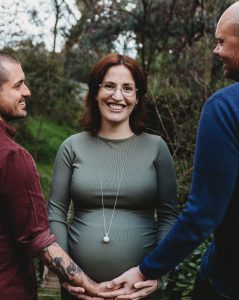
If you ever have any questions about surrogacy, please get in touch with me via messenger or email. I’ll help if I can. In the meantime, I hope you enjoy this episode. So we’re joined by Sarah now, and we’re going to hear about her surrogacy story. So we’ve got one photo here. So Sarah, I’ll get you to tell us who’s in this photo, but then clearly we’re going to go back to the beginning. will.
02:55
So who have we got in this photo? So there’s me and my husband, Matt, and our surrogate, Katherine, in the middle there. And that was one of the transfers that we did over the years. We certainly didn’t get a photo every single time. That photo on the right, that was the successful transfer that happened in March last year. I actually had COVID, so we were at home. So that’s you can sort of see me there on the FaceTime. I took a little photo, but every other transfer we were there with Katherine,
03:25
holding hands, so I was holding Katherine’s hands and my husband was holding mine. But that last one that we did. one. Yes. And it’s fascinating that surrogates often joke, know, they’ve never usually had so many people in the room while they get pregnant and sometimes their own husband’s not even in the room. Yeah.
03:42
Definitely by the time you got to so many transfers there. Sort of take us back to the beginning of it, Sarah. We see you needed surrogacy in the end of your journey, but what brought you to the need of needing surrogacy in your fertility journey? Yeah, sure. And us, my husband and I got married in 2014, of course, did what every new couple did and tried to get pregnant and were unable to. So we did some testing and we found that Matt had low sperm and I had low egg count, low AMH. And I needed a laparoscopy, which found that I had
04:13
endometriosis and I had blocked tubes as well, which was good. But yeah, so all of that trying that we did was never going to get us anywhere. Anyway, it’s just, started IVF in 2015 straight away. It was evident that my ovaries wouldn’t respond. So I was on the highest dose of all the medication. went on all the steroids, you name it. So we did multiple rounds in 2015 and the first half of 2016 because we were super determined.
04:42
to have a family. So all the transfers that we did were all fails. My doctor said, actually I mentioned it to my doctor and I said, I’ve got two younger sisters and my youngest sister, she’s nine years younger than me. And so I said, would it be better if we tried donor eggs? And the doctor was like, yep, absolutely. Let’s get those young eggs.
05:04
Yeah. And my sisters, both of my sisters had actually offered over the, over those couple of years. So you were sharing your journey with your family and they knew your struggles and so your sisters offered. Yep. um So the youngest one, she, she donated and we got five right embryos that we’d never, so none of my eggs had uh matured, like uh progressed as far as her has. So we were really hopeful with those. None of those took, they were all failures. So she donated again.
05:34
the following year and we decided to test those embryos and they were fine. They were all completely fine. So we transferred those again. One of them, had a miscarriage and then we had one more left of hers and that was a failure. I said to my doctor, I can’t, can’t do this anymore. And she didn’t want to either. So that had been 14 embryos that hadn’t resulted in a, in a live birth. And so my other sister had in that timeframe had her two bubs was breastfeeding and she said,
06:04
I’m next, I’m going to donate my ex work. You know, she felt like it too easily and accidentally. So she was super keen to donate. you were comfortable like at that point, got to that point of going, okay, it won’t be me, but it’s still got a some genetic connection. Yeah. So.
06:22
So with all of the donations, with the egg donations, I was so proud of my sisters that they could help me because they knew that I would have done that for them. Our mother’s a midwife and she talked to us a lot growing up about birthing and she actually even cared for the first surrogate family in Canberra back in the late 80s or 90s. So we knew about, you know, women helping women particularly. So it was always a very comfortable thing for us. When my second sister donated at that point she was married
06:52
married and she had kids. So the counselling was a bit more in depth and we had to have good conversations with my brother-in-law and my sister about that donation and what that would mean for their kids. Whereas at the time that my first sister donated, she didn’t have children. it was sort of a bit, little bit easier. Over that time, I’d also had more laparoscopies, more investigations, and it just got to the point where, yeah, I was completely and totally.
07:18
over it and your body wasn’t saying yes. Yeah and my doctor just said you know we could keep going or we could find someone that you know has successfully had children before and so we were sort of in a holding pattern we had no embryos and we knew we needed surrogacy and so what I did was exactly what you were saying to do before and I did a Facebook post ah and it was a few weeks before that I’d actually had lunch with a friend who I’d been doing IVF at the same time and she actually had a baby and she said now I have a friend who
07:47
has been offering to me throughout my IVF journey to help. Do you want me to tell her about you? And you, it is very overwhelming when you’re told you need surrogacy and you are drinking from a fire hose of information. And I was like, yeah, happy for you to mention it. But, and I knew we had months cause my sister was still breastfeeding. So we had a long time until we were to create embryos anyway. We did a Facebook post. I actually had a couple of people reach out from that post and said, I’ll do it. Yeah. Which can be a bit daunting and a bit weird. Yeah. You sort of want to talk
08:17
people about it and and I said to my husband how do we say thanks but no thanks or um they might not be the right fit for you it’s very generous of them would you mind if we talked about it so that was sort of happening in the background and then I went and had lunch with with Katherine and our mutual friend and I was so nervous that have been like dating wouldn’t it I was so nervous like it yeah it was a blind date but thankfully my friend was there and her new bub so we got to sort of dote on him at the end of that sort of lunch we said well we’ll catch up and
08:47
introduce her to Matt. So Katherine is single and she has her kids week on week off. So it was really easy for us in those early stages to date because we could just, you know, on her kid free weekend, we organized a really nice dinner or some sort of activity. And yeah, so she was keen from the get go. She was like, yeah, we’re doing this. And Matt and I were like, let’s get to know each other. You know, we’ve got to create the embryos. We also needed some downtime after all of our, I by that time.
09:17
have been four years, no five years of intense, you know, trying to get pregnant and we just needed a break, both financially and physically and emotionally. So we were keen to just sort of get to know her and meet her kids and everything. And once we felt more confident, once we had embryos created, then we were more serious. Like we always knew it was going to happen with Catherine. So over the course of 2019, yeah, so we dated, created the embryos and then we did our counseling and legals at the end
09:47
2019 ready to start transfers in 2020. So what’s the time frame there from when you sort of had that first date to when you went yes let’s start all the counseling legals. Do you remember the time frame of that? It was at least six months so we met in January 2019 and my sister created embryos sort of mid to late 2019. So that’s good.
10:09
Can I say for people listening who are brand new, that’s highly recommended at least six months to just get to know each other and see if you’re a good fit for each other before that because then it might still take another six weeks to do that paperwork which is fine because then it’s at least a year before you’re pregnant because you wouldn’t you know get pregnant on a first date with somebody. Well if you do.
10:28
Well done. Well yeah, you’re jealous because it doesn’t want to tell you that you’re oh, these people that sneeze and get pregnant. Yes, yes. Okay, because we knew that embryos had to have quarantine anyway, Anna. So, you know, so we had time up our sleeve. At that point, we thought, yep, we’re fine. I think I come back to what Matt and I needed and we needed that space and that time. You know, we always wanted to create a family and have a family and have a baby, but it gets so intense when you’ve been doing sort of heavy treatment for many years that it’s actually one of my
10:58
lessons is that you do need those good breaks along the way to just take a breather and it’s sort of counterintuitive because you think the months are ticking by. But yes, you almost need to take annual leave from the project. oh Just have a break from that. It’s quite healthy, isn’t it? But you probably didn’t do much travel or not expensive travel in those four years of all of your things. So yeah, you didn’t get much of a break. Your summer is a very expensive baby, very wanted child here. uh
11:23
I dare ask you how much it’s all cost anybody else. Yeah, I’m sure I could work it out if someone wanted to know, but we don’t want to know. You just wanted children. So then you did start the embryo transfers, but then clearly it took a couple of years until it worked. Yeah, so.
11:41
Early 2020, we started with our transfers. I think we had… Oh, and then there’s COVID too. that… Yeah, we started transfers before COVID. We had one or two, I think before they said, no, we’ll have to pause for a little while. had, I think we might’ve had about four or five embryos from my sister. So we were, you know, super confident that they were going to work. All the blood tests were negative on blood test day. And so that was throughout 2020.
12:11
2020 and into 2021. did you run out of embryos? Ran out of embryos. And then had to, and your sister said, I’ll do another egg collection. Yeah. My sister, my sister said I’ll do another egg collection before she was moving to Perth. We had sort of a limited timeframe to get that done once we decided that, we’re going to do some more. Also throughout that time, we were talking to our fertility specialists about other testing and other things that Catherine, we could look at with Catherine because it was, it’s very uncommon for a surrogate not to get pregnant after.
12:41
many, many transfers. so we did the second lot of embryos we created, actually did PGS testing on them.
12:49
just to give us that next level of certainty. And we had two perfect, the clinic told us, these are the best embryos Matt and I have ever, ever had over the last six or seven years. And so they both were biochemical pregnancies where you sort of start pregnant and then the following week it sort of all dips down again. So that was a really, really tough time. And Catherine was, we were all becoming really, really upset. And I think as a surrogate,
13:15
team was probably one of our most, you know, trying times. And we asked for more support from the clinic. So our doctor actually referred us to another specialist. So we went through Genea and she referred us to a specialist through IBF Australia. So she reached out to colleagues from a different, you could say competing agency. Yeah. Yeah. And they’re two of the big clinics. Yeah. That’s great that they want this to happen for you. So, so hard to
13:45
as a surrogate we blame ourselves that it’s our body letting you down even though we’ve been pregnant before. Nobody ever really knows is it? It could be the embryos, it could be the uterus, it’s you just don’t know sometimes but you keep trying different tests. Was there something that needed to be done or it just worked one time? We did blood tests on Katherine and Matt and my sister and they all went off to like Spain and checked all these different typings and matchings and things and anyway and Katherine had a little operation so she had a hysteroscopy to
14:15
checked that everything was okay in her uterus. She was just so willing to drag us, you know, all the way to the finish line. Yeah. She was super happy just to keep going. Matt and I were getting pretty drained, pretty much ready to pull the pin, but we knew that, yeah, we might as well finish all the embryos. And so what the final…
14:34
embryo transfer that picture that you saw before our last embryo, actually wasn’t a tested embryo. So it was made in the last cycle, but it didn’t hatch safely to be tested. So we didn’t actually know if it was going to be successful. I’ve gone back to that photo now. It’s a good time. So it’s the last embryo. Lucky last, whatever you want to it. So much riding on that embryo and you got COVID.
15:01
And you think, oh, everything’s falling apart and then it worked. Yep. And then Catherine rang us the week later and yeah, she’d done a pregnancy test, all the other embryo transfers. We didn’t do the stick tests. She waited for the blood tests, but she said this one, she felt it. She felt pregnant and she was. And then here’s a photo of her being pregnant, right? Yes. Yeah. So that’s when we sort of made the big announcement. Being Catherine’s fourth pregnancy, she did start showing pretty early in our relationship. We talked a lot over the years about
15:30
who would know what when. We were really, for Catherine Circle and her uh family and friends and work and her children and her ex-partner and the children’s parents, other parents, we were guided by her for a lot of it because it is her doing all this caring and everything and she was on lots of medication and…
15:50
Yeah, so we were really guided by her, this was the this we were about 16 weeks I think here. um And so we just sort of I let work know I think my husband let work know we’d sort of let our family know. uh
16:03
a weeks before that, but yeah, it was when we sort of went public. Public. What a beautiful photo. Big smiles on all your faces there. I hope I’ve got the photos in the right order, but apologies if I haven’t. But sometimes, you know, the right with the pedicures and the manicures, this is sort of the classic things that you do in pregnancy, isn’t it? And then you can treat yourself to it and hang out together, that sort of thing. Yeah, we did. we that was that day. We um Catherine’s body was really starting to change. That was early on in the piece. And so we went shopping and she just needed some work pants and, you know, maternity bras and those.
16:33
sort of things and we decided to get our toes done and we had a really lovely day, just the two of us. Like most of the times we were together, Matt was included, but there were some things where it was a little bit uncomfortable for Matt, like he doesn’t need to be there for bras and trying on maternity clothes, you know, so he was very comfortable with letting us. um
16:53
having the day together. I that’s beautiful things. I’m sure perhaps there was maybe conversations in some of those shops about, know, oh, you when you’re trying on maternity bras and the women possibly helping you or helping Katherine might be like, oh, and when are you due? And she might say, well, actually, I’m carrying for this. There was a good example of that where the mum, so my mum and Matt’s mum, we took Katherine out for lunch and we all went and got a pedicure that day. And they were saying, oh, your baby. And she’s pointing to me saying it’s my baby. And they’re like, oh, lesbian.
17:23
and so Catherine’s like no but anyway you know so it is. So sometimes you tell people but depending on the circumstance sometimes you might not. Yes these are the conversations that happen in surrogacy aren’t they? Yeah there was nothing really overly awkward about it at all. Yeah so that photo before with Catherine and on the couch and this one here we sort of had a weekend of my sister um the other redhead there, she’d come over from Perth and then Matt’s brother to the left of him with the glasses came down from Brisbane and we had a family weekend where we just spent the weekend with Catherine and
17:53
Matt and I got lots of gifts, but everyone got to meet Catherine properly. The parents and brothers and sisters had met her, but the extended family and people just wanted to hug her and touch the belly, which she absolutely adored. So that was a really nice weekend where we got to celebrate a little bit. Modern families here in the making. And then that brings us to birth, hey? Talk us through that. So we had planned an induction at 39 weeks. So Catherine, all her three
18:23
Previous pregnancies were spontaneous labor delivered at 40-ish weeks in the birth center through the public system in Canberra. So we assumed that’s what Catherine wanted to do again. So we discussed what she wanted. When we felt pregnant with Summer, our fertility specialist said, you’re not going through the public system. She was like, you’re not leaving here from like when we went and saw her about six weeks or whatever, seven weeks, she said, you’re not leaving here until you agree with me because you know, she’s closer to the system, but it was, it was not that the system was bad. It’s just that they were busy.
18:53
Catherine’s older now, so at the time we were about 39 and you know, being the fourth pregnancy and then also all the medications that Catherine had been on and the years and years of getting trying to get pregnant, our doctor said, I’m not sure what your placenta is going to do and I’d prefer that you got tracked regularly. So we actually went through a private obstetrician through a private hospital. Catherine was okay with that? Yeah, it took her a little while to come to that. And one of the reasons, just speaking on her behalf a little bit is around the money. She didn’t want to, her,
19:23
was really like, I don’t want you guys to keep having to spend all this money, you we’re pregnant now, you know, I’ve done this before. We took a few conversations of Matt and I saying it’s the last 10 % or less of what.
19:34
our entire journey and we wanted… pregnancy is quite cheap in comparison to everything else, isn’t it? Yeah, yeah. And we wanted her safety and in the end, we were all really comfortable because we did scans every three weeks. You you’re just so handheld by the obstetrician and she said she didn’t get that with her other pregnancies. So we got to see Summer every three weeks and her body change, you know, on the the scans and the placenta was checked.
20:00
and whatever Katherine needed at the time she got. So it’s definitely something to talk about in your surrogacy team, but be prepared that things can change. I was just going to say that the good lessons here is that, you know, often the surrogate might lead the way with the conversations about pregnancy and birth, but then as a team.
20:16
being open to it and that you might’ve had that plan prior to pregnancy and then due to doctor recommendations and whatever, you had to reflect as a team and make an adjustment there. So that’s a good lesson as a team. And you want to have had some time to get to know each other by that point. You don’t wanna be making these medical changing decisions if it’s a…
20:35
complete stranger, you want to have that time together. So it sounds like your team really well together. And then the next one was around the birth. we were planning at 37 weeks, summer was head down and we’re ready for an induction at 39 weeks. So at 38 weeks, we just went in for the final checkup and
20:54
I’d only stopped working the day before. Catherine had stopped working many weeks before, but then Matt was still working. Summer was, was breach at that appointment and the cord was around her neck a couple of times. And so the doctor said, Oh, let’s meet her tomorrow. We’ll do a seizure tomorrow. And so that was a whirlwind spin uh of, okay. Baby’s coming a week before we planned and firing up alternative delivery method. was lots of conversations and talking about how it would all work. Even down to the point where we didn’t, and I didn’t
21:24
have a room the first night in the private hospital because they were so busy. So that was one of the considerations was do we wait a few days until they have a room ready, which the hospital was pushing us to do, but Katherine wasn’t comfortable and neither were we because Katherine was very worried about summer because the cord was around and she said, I can’t sit here for three days or four days monitoring her movements 24 hours a day. Yeah, fair enough. Yeah. So we decided to go ahead and yeah. Best day ever. You became a mum that day, Sarah. Yep. Yep. Yep.
21:54
So yeah, that first hole, right? Full of emotions. Yeah. Oh, I just couldn’t believe it. And what was really nice about that theater was that we were off to the side, but Katherine had direct visibility. She could see us doing the checks with the pediatrician, me doing the skin to skin. that was, Katherine was very clear that even if with the vaginal birth, she, cause I’m an ex nurse, she was like, can I catch as in me, can I catch it and put her on my chest? That was our plan in the vaginal birth. So we always wanted to do skin to skin straight away. Yeah. And we got to do all that.
22:24
in a bit of a different context.
22:28
you Katherine having her cuddles too. Yeah. So we all got to go with Katherine back to recovery. Actually, we were together for another 24 hours after that. So Summer and I stayed in the room with Katherine that first night. I think other teams, I don’t know how comfortable they would be with that. For me, I think Katherine would have been okay if we had stayed in a separate room and she had stayed in with her mum. But in the end, again, being the ex-nurse, I could actually, while Summer was
22:58
sleeping, help Katherine, you know, and do some of those personal cares with her. And even the next morning I helped her have a shower and we got to really have a really nice 24 hours in that transition from.
23:10
of summer from Katherine over to me was also me caring for Katherine. It wasn’t just that the baby being handed over. So that’s beautiful. I your team did that really well. And it’s really helpful for people at the beginning of their journey to hear my example, your example. that although you were strangers to start with, here’s the bond that you developed and that you do want to be near your surrogate because she’s your friend and you want to enjoy celebrating this baby together and making sure your friends. Okay. So I’ll just add, I think
23:40
quite a common thing is often for people to, as you say, have rooms next to each other in the hospital for a couple of nights, depending on how busy hospitals are. Sometimes you might be in the same room, but these are all conversations to have as a team, they? Yeah, we had gone into the hospital prior to the birth to confirm that we would have our own room and all that sort of stuff. So that picture on the right there is us in our room. And I think that was day two and Catherine, so she’s been expressing throughout this time and she,
24:07
came in and actually gave Summer one of the bottles. So it was when she was really feeling quite those baby blues and you know, where you sort of have that big hormone dump and yeah, she, it was lovely because she got to come in and give Summer a bottle. But yeah, we were just walking across to each other’s rooms, checking up on each other. Yeah, it was lovely.
24:24
a lovely few days. And then that part of the journey ends so you leave hospital separately. Yes, yes and the other so you can see those little red booties there so all of Katherine’s kids left hospital wearing those booties so there’s a I think it’s a Brazilian um sort of tradition that if you leave the hospital wearing red and I’m not sure if it’s red booties but red brings prosperity to your life and it’s to be very positive and Katherine said to me oh if I can find those booties can um our baby wear them and
24:54
Matt and I were like, yes, find them, find them. Because, you know, she’s moved house and separated from her partner. So she was really happy to find them and she got to put them on summer and her kids were there and her mum was there. although that you can’t see them, they’re all there with us as we were leaving. Oh, that’s beautiful. It’s the village, isn’t it? Coming together and then speaking of sons, is this one of summer’s uh children?
25:16
youngest um son. in those first few days, we sort of followed Katrina Hale’s advice where we saw each other every second day and we sort of needed to for the breast milk anyway. So Katherine is still nearly three months later donating her pumping, expressing and donating milk to us. Yeah, The kids got to see Summer quite a lot and you know, as school holidays happened and everything. So we’d go over to Katherine’s because she couldn’t drive in those first little, that first little while and then
25:46
she was free to drive, um would come to our place and we sort of stretched out now to about every 10 days. That’s wonderful. Well, what a wonderful photo summary. And when I had this photo, I wasn’t sure where in your journey this fell, but this is an example of Yeah, so Christmas, this is our Christmas celebration at a Japanese restaurant in Canberra. So the three of us and Summer went out. is on maternity leave still. and I really wanted to, we love this restaurant and we really wanted to take Catherine as a Christian.
26:16
Christmas presents. So Matt’s there and Summer’s there and yeah, we just had a nice lunch and sushi, lots of sushi. And I think these are some great examples of what surrogacy can look like to people and so who are right at the beginning and imagining, you know.
26:31
We’ve shared this story of what this team can look like. So thank you. It’s a beautiful story. Yeah, no worries. I could ask you lots of questions, but we’ve had one, but it’s come through in the chat section. So I’ll read that one out. But anybody else, feel free to type them in. We do have time for some questions. We may have covered a lot of what you wanted, anybody wanted to ask anyway. So is it Harmony has said, thank you, Sarah, for sharing your journey. Yes. As she says, it’s an amazing example of persistence and determination in what everyone’s gone through to bring summer here. Her question is, she’s wondering if
27:01
IUIs, interuterine ride insemination, for those that may not know what that is, and was ever trialed with your sister Catherine rather than embryo transfers. I think what you mean would be Catherine’s egg. It would have to be Catherine’s egg. In the ACT, you can’t do…
27:15
So you can’t do traditional surrogacy. So it’s really important for everyone to really understand the laws of their own state. Catherine would have a hundred percent donated her eggs or done traditional surrogacy. Yes. But in the ACT, we actually can’t. uh Yes. You’re the only state, sorry. I’m pretty sure at the moment. So each state has little quirks like that. that’s, yeah. Hopefully that will be changed the next time they. looked at moving to Queenbyn, you know, just down the road and renting and.
27:44
We didn’t really, but you know, was a conversation. For her, she was really yearning to carry for us. And yeah, it was definitely a conversation that came up. And good question, because some surrogates do offer traditional surrogacy. Certainly once you’ve been down that track, I offered it because I said,
27:59
We ran out of embryos from the first time around. So we’re like, what are we going to do? Had another question come through in the chat, but people try and head them over to the Q and A box. If you can find it there. Tim asks the different state laws. What happens if you and your partner live in different states? Maybe I’ll try and field that one. My first instant answer to him is don’t. How can you be? By the time I’m to do surrogacy, do try and live in the same state. I’ve had a team join SASS and when they join, they were in different states, but they were moving within six months to join each other.
28:28
I’m not sure Tim, in my six years in the community I don’t know of a team where that’s ever happened. I know of somebody that travels for work, you know, interstate a bit, that would be tricky. And think about it from a surrogate’s point of view, it’s either going to be somebody that you already know or if it’s somebody that’s new getting to know you, she’s wanting to get to know both of you and so she needs to be spending time with you. She also wants to visualize where Bubs is going to live and the house and her kids are going to want to see that house. And the idea is a split household straight up. So try and think of it from the surrogate’s point of view.
28:58
what she might be envisaging. I can appreciate though that that might be tricky due to your work and family situations. Do start to consider that while you’re on the beginning of this surrogacy journey. Did you want to add anything on that Sarah? Oh was going to say yeah I completely agree. I start like you’re to end. Yeah start like going to end. Yeah good good point on that. Anything in your own journey as a team that you would do differently if you had your time again? I don’t yeah yeah because you sort of mentioned that to me before and I don’t think there’s anything overly different. think that’s good. We had a couple of challenges around the IVF clinic
29:28
I think it’s important to know their policies and the way they approach surrogacy and especially if you’re using donors, those sort of edge cases can be a bit wild, particularly for couples that maybe have been doing fertility treatment, don’t assume that the same treatment and policies flow through. Yeah, in terms of differently, yeah, that would be it. Just maybe- Is it okay to question your IVF clinic or to even move? Absolutely, yes. Yes, for sure. You’re the patient, you’re the customer, you’re paying the money and-
29:57
Yep, definitely. And I think that’s, although you might have trust in your doctor, you might want second opinions or you might have heard from other people through the surrogacy community by that point of who’s got experience or in unique cases. So it’s okay to move. It’s also okay to say no to a surrogate too. You know, if you don’t click with somebody at the beginning, even though they might be rare, surrogates coming along, but it’s got to be a good fit, doesn’t it? Yeah, absolutely. One example was it was my old boss that actually offered and I said to my husband, I already feel a bit, not the right way, but subordinate to her.
30:27
just, I don’t know if I would ever feel equal enough with her to, yeah. So you’ve got to think about things like that as desperate as you are or as much as you want to be a parent. m That’s a great scenario. might use that in future as an example, because there was a previous hierarchy. that’s a good example. Someone’s typed in, is there a cutoff age for IPs? I’ll field that one and say not legally in Australia, but it’s the IVF clinics that might have a preference. so ultimately at the end of the day, you have to go by the IVF clinic rules.
30:57
My understanding is it’s about 52, provided if you’re an IVF, if you’re a couple, at least one is below that. So one of you might be 50, 51, the other might be mid 50s. But no, there’s no legal law in Australia, but if your clinic says, no, we’re not going to do it, then find a new clinic or you might be struggling. So I hope that helps anonymous to answer your question. I hope you’re in the age range there. And for surrogates, at least 25, just about every state in Australia. And again, no cutoff age, how the surrogate can be. I know of one that was, I think 54 last
31:27
She carried her daughter was born without a uterus and she carried her grandson in Tasmania.
31:32
It’s amazing. So there’s that one. And is there any sort of advice then you’d give Sarah to people at the beginning of their journey? Yeah, I think, yeah, be careful with who you select. Definitely always have that open communication and, you know, have those tough conversations. It’s, it’s bigger than like a job or you even have to sometimes talk about things that you wouldn’t talk about with your own, you know, life partner in surrogacy. Like I don’t think any couple, whatever, have you talk about the things that we had to talk about, you know, with Kathryn, I think also
32:02
put in the effort to get to know the surrogates support network, right? So they need to know that no matter what happens, you’ve got their best interests. So I heard it on one of the surrogate, I think podcasts years ago about surrogacy. And so for Catherine, she and her family have everything to lose in this process and we have everything to gain. So they want to know her, like she’s a single mom, she’s got the three kids, everything to her that happened to her. What would that mean? You know, she also helps care for
32:32
her father, her mother needed that support. So all that sort of stuff really needs to be thought about and discussed. And you have to be open and honest and kind um through all that.
32:45
m I like that. because you’re supporting a single mums and so you have to get to know the other people that when you’re not necessarily the one there for support, yes, you guys live locally, but for interstate teams can be trickier and you’re not there all the time. And sometimes it will be the surrogates family that pick up the slack. And so getting to know them, knowing how you can help, that’s some really good advice there.
33:05
I think we’ll finish with one last question. Kyla asked the question, what was the toughest topic your team had to discuss that might jump into your mind? Yeah, I think that’s a pretty easy one. So all the other conversations that we had to do through the counseling and legals and all that sort of stuff, like there’s a lot of written information. There’s a lot of guidance, you know, through different forums and things that has what you sort of need to discuss. They were sort of easy.
33:27
where we got a little bit challenged was when things weren’t going well. So when the transfers weren’t working and our doctor said, well, I want to do a laparoscopy on Katherine and I’ve had a few of those now and they’re not, even though they’re keyhole day surgery, they are not simple procedures coming from my own experience. And I was adamant that that was not to happen. And Katherine, she has bodily autonomy and she wanted to do anything. She would do anything to give us a baby. There were conversations where she was like, no,
33:57
to do what I want to do it. And I said, no, I’m not willing to, I didn’t want her to have to go through that. And for the reason I just discussed, you know, she’s got three kids, you know, single mom, she needs to work all that sort of stuff. And it wasn’t uh like, we didn’t have an argument or anything, but it was something where we had to both, we just have to be honest and, know, she had her reasons. had mine and we accepted that. Yeah. It was one of the times I think I discussed it at detail with my psychologist. So any IPs out there, make sure you’ve got your own.
34:27
know, independent support for sure. And she said to me, know, Catherine wouldn’t do it if she didn’t want to. And I, like, I agree with that, but Catherine was making a decision based on her thinking it was going to get us pregnant. Whereas I’m thinking of the recovery and all that sort of stuff. And so, yeah, we didn’t end up having it. We just did the hysteroscopy instead, which was fine. Her uterus is absolutely beautiful. then, and that was a bit of the clinician, ex-clinician in me, being an ex-nurse, there was no clinical reason that I could see, but my doctor was, I want to see.
34:57
I want to know what’s going on.
34:59
They want to throw everything at it. Everybody’s coming with the right intentions. They want to see you all get pregnant. I think you’re an interesting IP. I wish they were all like you in terms of saying no to some of the medical things for surrogates because sometimes it’s the IPs through that desperation to become parents and the doctors say we’ll chuck all of the things at it, all the tests and surrogates often have to be the ones going, I don’t want it all. I can get pregnant. And so yes, that can often create discussions as a team there. So I think that’s a really good one to flag for people um to discuss. What if a doctor recommends
35:29
this? What are we going to do in that scenario? You might not be able to talk through every scenario before it happens. Things are going to come up.
35:37
that you can’t prepare for. But if you’ve got that open communication and trust there, which, you know, it’s there when you start. But unfortunately for us, the more times it didn’t work, the stronger our relationship got. Unfortunately or fortunately, whichever way you look at it. And so, yeah, very firm team by the end and beautiful to see you all continuing catch up and the milk is still flowing from Catherine there. She’s still helping some of us thrive there. Absolutely. And you get to be mum and dad. Yeah, wonderful. Thanks, Anna. It’s been great.
36:06
Thank you so much for joining me. On our YouTube channel, you will find many other episodes as well as the images mentioned in this webinar. If you’re looking for more resources, check out the show notes for this episode and consider joining us for one of our webinars so you can have your questions answered on the spot. Please subscribe to this podcast if you found it valuable and share it with someone so they too can benefit from this conversation. Until next time, welcome to the village.
Looking to find a surrogate in Australia? Consider joining SASS.
Looking for an overview of surrogacy? Join us in a free, fortnightly Wednesday night webinar.
Looking to chat with other IPs and surrogates in a casual setting? Join us for a monthly Zoom catch up, one Friday of each month.
Looking to hear stories from parents through surrogacy and surrogates? Listen to our podcast series or watch episodes on our YouTube channel.
Looking for support one-on-one? Register for SASS to connect with me – your Siri for Surrogacy, or book in for a private consultation sass@surrogacyaustralia.org